
Donec efficitur, ligula ut lacinia
viverra, lorem lacus.
Donec efficitur, ligula ut lacinia
viverra, lorem lacus.
Most photographers discover macro photography by accident — a flower catches the light, they move in close, and suddenly the frame is full of something they’ve never seen before. That moment of discovery is exactly what keeps macro shooters coming back. But there’s a gap between that first accidental close-up and a genuinely great macro photo, and it usually comes down to a handful of technique problems nobody warned you about.
This guide covers everything from choosing the right gear to editing your final shots in 2026, including the AI-powered tools that have changed the workflow significantly.
Photo: Unsplash
Macro photography is the art of capturing subjects at extreme close range — typically at a 1:1 magnification ratio or greater, meaning the subject appears life-size (or larger) on the camera sensor. A true macro lens reproduces tiny subjects at their actual size on the sensor plane. That’s not just zooming in; it’s physically getting close enough that a 1cm insect fills your frame.
What separates macro from regular close-up photography is that magnification ratio. Zoom in with a 200mm telephoto and you’ll get a close-up. Use a dedicated macro lens at 1:1 and you get something different — textures, structures, and details the naked eye simply can’t resolve. The world of macro photography operates at a scale most people never consciously observe.
Sharp focus on the right part of the subject. That’s the short answer. At 1:1 magnification the depth of field shrinks to millimeters — sometimes less — so even a gentle exhale can shift the plane of focus enough to ruin a shot.
Beyond sharpness, good macro photography has three qualities: a subject worth magnifying (not every small thing is interesting at close range), intentional background treatment (busy backgrounds kill macro shots), and light that reveals texture rather than flattening it. When those three elements align, the result is a stunning macro image that holds the viewer’s attention.
A dedicated macro lens is the single most impactful piece of gear you can buy for this type of shooting. The most popular focal lengths are 90mm, 100mm, and 105mm — and for good reason. At those focal lengths you get true 1:1 magnification with enough working distance to light your subject without your lens barrel casting a shadow.
Canon’s RF 100mm f/2.8L Macro IS, Sony’s FE 90mm f/2.8 Macro G OSS, and Nikon’s Z MC 105mm f/2.8 VR S are the current benchmarks in 2026. Tamron’s 90mm and Sigma’s 105mm Art remain excellent value options if you’re not ready to go first-party. The 60mm options are cheaper but force you to work much closer to your subject — that makes lighting difficult and spooks insects.
Mirrorless systems have a concrete advantage here: focus peaking and live histogram in the viewfinder make manual focus — which you’ll use constantly in macro work — significantly more precise. The Sony A7R V and Canon R5 Mark II also offer pixel-shift modes that improve fine detail resolution beyond what the sensor normally delivers. That matters when you’re photographing the edge of a petal or the compound eye of a bee.
That said, a well-maintained DSLR like the Nikon D850 or Canon 5DS R is still perfectly capable. The camera body matters less than the lens and your technique.
A sturdy tripod is non-negotiable for studio macro work. Indoors with a static subject, there’s no excuse for camera shake — and at high magnification, even vibration from the shutter can blur an image. Use a remote shutter release or the camera’s 2-second timer.
A macro focusing rail lets you move the camera forward and backward in precise increments rather than twisting the focus ring. This is essential for focus stacking — you take multiple shots at slightly different focus points and merge them in software. The result is a level of sharpness you can’t achieve in a single frame.
A ring flash or twin-lite flash system solves the lighting problem that kills most indoor macro shots. At close distances, natural light often creates harsh shadows. Dedicated macro flashes like the Canon MR-14EX III or Godox MF-R76 give you controllable, diffused light right at the front of the lens.
Shooting outdoors changes everything. Wind moves your subject constantly, light changes by the minute, and you can’t use a cable release. Most macro nature photographers shoot handheld at 1/250s or faster, with flash as fill to freeze motion and sharpen details. A monopod gives useful stability without the setup time of a tripod. Wear dark, muted clothing — insects notice movement and contrast.

Photo: Unsplash
Not everything looks good up close. The best macro subjects have two qualities: interesting micro-texture (scales, cells, fiber structures) and a shape that translates well to a two-dimensional frame. Flowers and plants are the obvious starting point — easy to find, stationary, and endlessly varied. Insects offer more drama but require patience and speed. Water droplets, frost crystals, and fabric weaves are underrated subjects that beginners overlook.
One practical test: hold the subject (or your phone) about 10cm from your eye and look at it. Does it reveal something unexpected? That’s a good macro subject.
Early in the morning is the classic macro window for outdoor shooting. Insects are slower when cold, dew sits on surfaces, and the light is soft and directional. Overcast days work well for diffused, even illumination without harsh shadows. Midday direct sun is the hardest condition — it creates blown highlights and deep shadows simultaneously.
For studio or garden macro: tripod, mirror lockup (on DSLRs), remote shutter. For field macro: raise your ISO enough to achieve 1/250s or faster, and brace against your body or a nearby surface. The blur from camera shake at 1:1 magnification is worse than the noise from ISO 1600 — that’s a trade-off worth making.
The background in macro work is usually an out-of-focus wash of color, but the color still matters. A complementary or neutral tone behind your subject lets it breathe; a cluttered or contrasty background divides the viewer’s attention. Carry a few sheets of colored card stock when shooting in the garden — placed at the right distance behind the subject, they create clean backgrounds without any post-processing.
Natural light works beautifully when it’s soft and angled — a window diffused by thin cloud, or shade light from the side. The problem is control. Macro photography lighting with a dedicated flash gives you consistent exposure across a session and lets you freeze any residual subject movement. Position the flash slightly to the side rather than straight on; flat front lighting removes the shadow that creates the perception of depth and texture.
Photo: Unsplash
Extension tubes and close-up filters are entry-level options. They work, but they introduce aberrations and reduce autofocus capability. If you’re serious about macro photography, a dedicated macro lens pays for itself in image quality and consistency within the first shooting session.
Shallow depth of field at f/2.8 creates beautiful bokeh but renders only a razor-thin slice of the subject sharp. Stopping down to f/8–f/11 gives you more depth, but also increases diffraction, which softens the image. The sweet spot depends on the lens; most 100mm macros are sharpest between f/5.6 and f/8. Test your specific lens — don’t assume.
Autofocus struggles at macro distances. The camera often hunts, latching onto a background element or the wrong part of your subject. Focus manually and use focus peaking (on mirrorless) or live view magnification (on DSLRs) to confirm sharpness before shooting. Once you learn to focus manually at macro scale, it’s faster than waiting for AF to cooperate.
A macro focusing rail for stacking work, a diffuser for your flash, a small reflector (even a folded piece of white card) to fill shadow on the dark side of a subject — these small items change the quality of your results more than any camera upgrade.
The rule of thirds applies in macro just as in any other photography. But the frame is so tight that your subject positioning relative to the focal plane matters more than placement on the grid. Make a deliberate choice about which part of the subject is in focus — usually the eye of an insect or the center of a flower — and compose around that decision.
Focus stacking involves shooting a series of frames with slightly different focus points, then blending them into a single image with greater depth of field than any single shot could deliver. Take multiple frames at consistent intervals using a focusing rail, then merge them in Lightroom’s Enhance panel or Helicon Focus. The result — an entire subject sharp from front to back — is something impossible to achieve in a single exposure at 1:1 magnification.
Macro nature photography is slow. An insect will sit still eventually; a drop of water will form the perfect shape; the light will shift into position. Rushing produces blurred, poorly composed frames. Professional macro photographers routinely spend 30–60 minutes on a single subject. That patience is part of the discipline.
Direct noon sunlight is the enemy of macro work outdoors. The shadows are too deep, the highlights blow out on reflective surfaces, and the contrast ratio exceeds what a camera sensor can handle in a single frame. Work early, work late, or work on overcast days.
Macro images often need more micro-contrast enhancement than regular photos — the detail you captured deserves to be seen. Bring up the Clarity or Texture slider before touching overall contrast. Correct white balance carefully; flash and natural light mix unpredictably in macro work.
Lightroom’s built-in focus stacking (under Photo > Photo Merge > HDR/Focus) handles most standard stacking jobs. For complex subjects with crossing planes — like a coiled insect or an overlapping flower — Helicon Focus or Zerene Stacker gives you more control over the blending algorithm. Adobe Photoshop’s Auto-Blend Layers function also works well for simpler stacks.
Modern AI-powered sharpening tools have changed the post-processing workflow in 2026. Topaz Sharpen AI and Lightroom’s AI-powered Denoise & Enhance features can recover detail from slightly soft frames that previously would have been deleted. Don’t over-sharpen — haloing around fine structures like hair or fiber is immediately obvious in macro images and looks worse than soft detail.
If focus stacking feels too technical at the start, work with selective focus intentionally. Choose one sharp element — a single stamen, one eye, one droplet — and let everything else fall into blur. This isn’t a compromise; it’s a legitimate technique that draws the viewer’s eye exactly where you want it.
Smooth, out-of-focus backgrounds (bokeh) come from a combination of large aperture, long focal length, and distance between the subject and what’s behind it. At macro distances, even f/8 produces attractive background blur because the magnification ratio amplifies the effect. To intensify it, increase the distance behind your subject — move your subject away from the background, not just closer to the lens.
Freelensing involves detaching your lens from the camera body and tilting it manually to create a tilt-shift effect. At macro distances this produces surreal, selective-focus images with a look no post-processing filter can replicate. It requires clean hands, a dust-free environment, and no strong wind — sensor dust is the real risk here. Use it sparingly for creative abstract macro shots.
The parts of the frame outside your subject aren’t background noise — they’re compositional elements. A dark gap between two leaves can frame an insect more effectively than any artificial backdrop. Train yourself to look at the full frame, not just the subject in the center, before pressing the shutter.
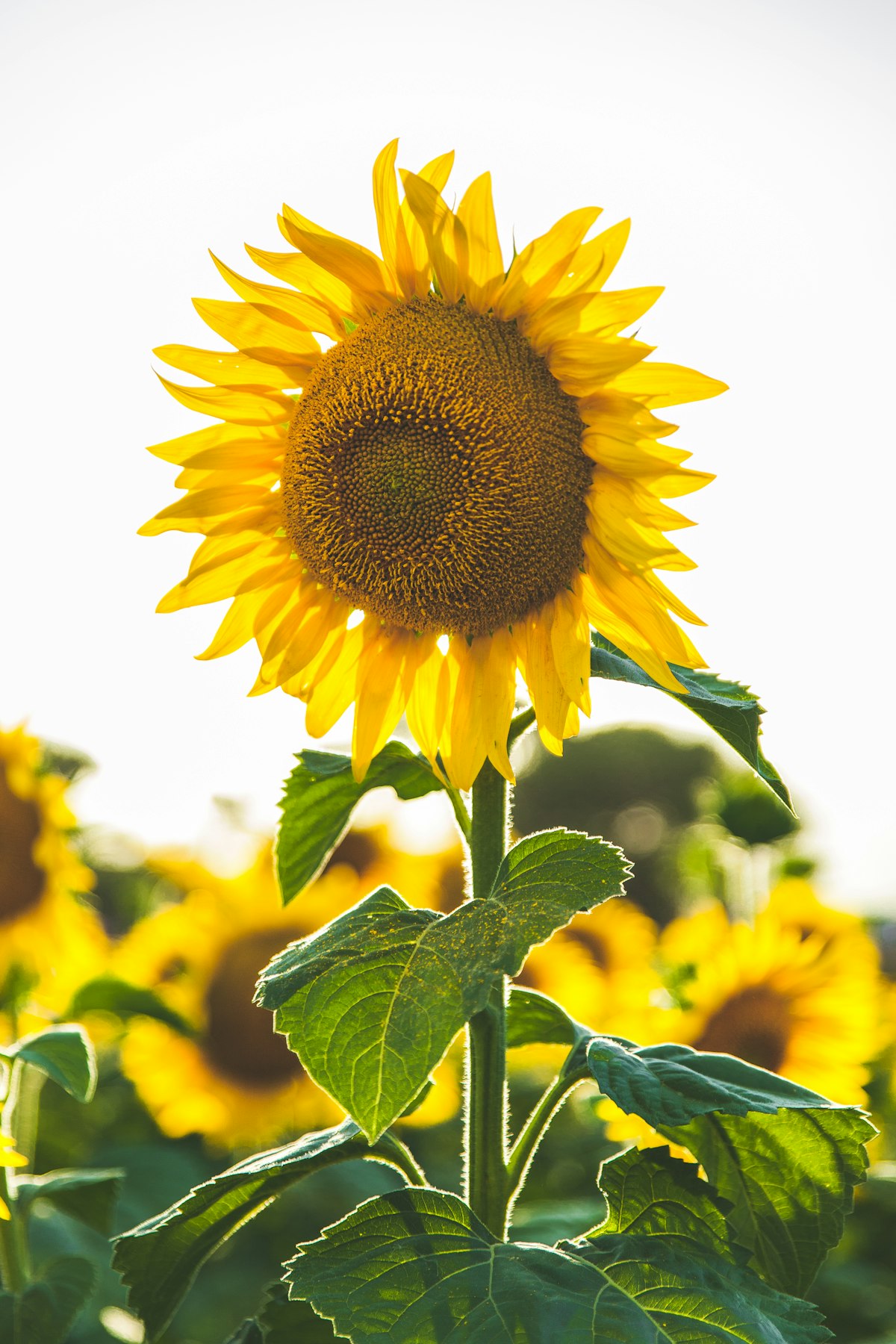
Photo: Unsplash
Flowers and plants dominate macro photography for practical reasons: they don’t move, they’re everywhere, and at close range they reveal extraordinary structures. The edge of a petal under side-lit macro shooting looks like an entirely different material than the petal you see with the naked eye. Insects are more challenging but more rewarding — a bee’s compound eye, a spider’s fangs, the scales on a butterfly wing are the kind of macro photography examples that genuinely surprise viewers.
Fabric weave, sugar crystals, the surface of corroded metal, condensation on a cold glass — ordinary objects become abstract studies in texture and pattern at macro scale. This is excellent practice for technical skills because the subjects stay still and you can control the light completely.
Soap bubbles, oil on water, the macro effect of light through a prism — these are subjects where the “subject” is really just a pretext for capturing color, form, and light. Some of the most striking macro photography examples published in 2025–2026 fall into this category. There are no rules about what qualifies; if it looks extraordinary through a macro lens, it is a macro subject.
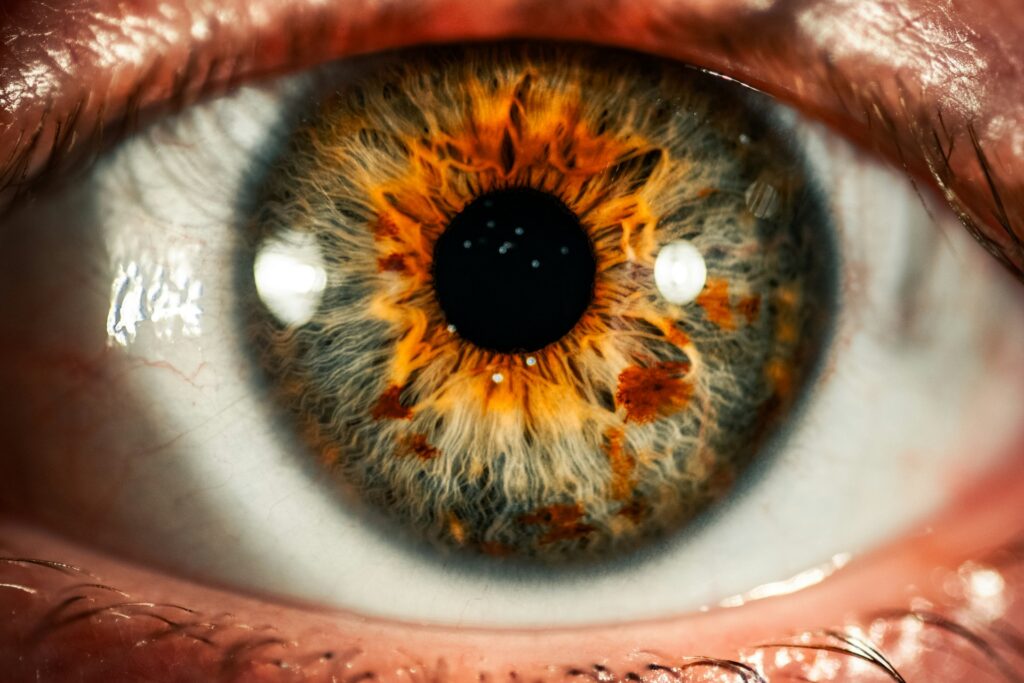
Super macro goes beyond 1:1. A 2:1 or 5:1 ratio means the subject projects onto the sensor at twice or five times its actual size. At these levels you’re photographing things measured in fractions of a millimeter — the facets of an eye, pollen grain structure, the crystalline lattice of a snowflake.
Getting there requires either specialist lenses (like the Laowa 25mm f/2.8 2.5-5x Ultra Macro), a reversed lens attached to an extension tube, or a microscope objective adapted to a mirrorless body. Camera shake becomes catastrophic at these magnifications — even vibrations from building HVAC systems register. Most super macro work is done on an optical table with electronic remote triggering.
The technical concepts are simple. The execution takes practice — mainly because depth of field is so shallow that focus placement is unforgiving. Plan on a few sessions of deliberate practice before your hit rate climbs to something satisfying. Most people who are struggling are fighting camera shake and auto-focus; solve those two problems first.
A telephoto lens can produce close-up photos, but it won’t achieve true macro photography at 1:1 magnification unless it has a dedicated macro mode. Telephoto lenses do have one advantage: greater working distance. At 300mm you can fill the frame with a butterfly while standing a meter away. But for true macro — the magnification ratio that defines the art form — you need a dedicated macro lens or extension tubes on your existing glass.
In everyday photography language, they’re used interchangeably — but technically, micro photography refers to imaging through a microscope (microscopy). Macro photography refers to close-up photography at or above 1:1 ratio without a microscope. Nikon uses “Micro-Nikkor” to describe their macro lenses, which adds to the confusion, but the imaging principle is the same: extreme close-up, life-size or larger on the sensor.
Yes, with limitations. Modern smartphones — the iPhone 16 Pro, Samsung Galaxy S25 Ultra, and Google Pixel 9 Pro in particular — have dedicated macro modes that deliver genuinely impressive close-up results. The working distance is very short (1–5cm typically), and depth of field control is limited. For learning to see at macro scale and practicing composition, a phone is perfectly adequate. For 1:1 magnification with controlled depth of field and full manual control, you need a dedicated camera system.
