
Donec efficitur, ligula ut lacinia
viverra, lorem lacus.
Donec efficitur, ligula ut lacinia
viverra, lorem lacus.
The game ends at 9:47 PM. By 10:15, the team’s social media manager needs images posted. By midnight, the wire editor wants selects filed. Nobody cares that you shot 4,000 frames — they care that three of them are in their inbox. This is the actual job description of sports photography in 2026, and every gear decision, autofocus setting, and post-processing choice connects directly to that deadline. Not abstractly. Directly.
Understanding the technology is necessary. But technology doesn’t matter if the workflow breaks down at 11 PM in a parking lot.

AI-powered autofocus systems are now widely described as approaching “magic” in real-world performance, particularly in fast-action scenarios such as wildlife and sports photography. Cameras can now anticipate motion trajectories, maintaining focus accuracy even in erratic conditions.
That’s not marketing language anymore. It’s describing something that practicing sports photographers feel in their keepers-per-burst ratio. Three years ago, a 60% sharp-frame rate on erratic soccer action was considered strong. Today, the Sony A9 III’s global shutter combined with its AI subject tracking routinely delivers above 80% usable frames in similar conditions — and that number shifts the entire downstream math. Fewer rejects means faster culling. Faster culling means earlier delivery.
Autofocus systems have evolved from reactive to predictive. Cameras can now anticipate motion trajectories, maintaining focus lock even in erratic scenarios such as birds in flight or sports action. The Canon EOS R1, designed specifically for elite sports environments, runs Action Priority AF that predicts subject movement using cross-type phase detection — a hardware approach to a problem that software alone couldn’t solve reliably. The result is consistent lock through partial occlusions, jersey-pile tackles, and the kind of edge-case chaos that used to produce entire memory cards of soft frames.
This changes how you set up, not just how you shoot. Wider AF area modes are now reliable where they previously weren’t. Zone tracking across the full frame — something most sports photographers avoided because it lost subjects in background confusion — now holds through scenarios that would have required manual area restriction two years ago.
The flagship tier in 2026 is genuinely exceptional. The Sony A1 II incorporates a dedicated AI processing unit for enhanced subject recognition, with a 50-megapixel stacked sensor delivering 30fps blackout-free shooting. The Canon EOS R1 offers up to 40fps bursts and pre-continuous shooting, with exceptional durability and advanced weather sealing suited to harsh conditions. The Nikon Z8 delivers blackout-free 20fps shooting from its 45.7MP stacked sensor, with advanced subject detection for nine subject types including athletes and balls.
The honest truth: for most working sports photographers, the mid-tier is now the rational choice. The Nikon Z8 at roughly $4,000 performs within touching distance of the Z9 at twice the price. The Canon EOS R5 Mark II shoots 40fps RAW with a buffer holding over 500 frames — deep enough for extended play sequences without interruption. These aren’t compromises. They’re complete tools.
Three-year-old flagship models sell used for $1,500–$2,000. They do everything you need. They take excellent images. The only reason to upgrade is if you specifically need the newer features. For most photographers, you don’t.
Where that logic breaks: low-light indoor arenas. A high-school basketball gym running mixed metal halide and LED lighting at ISO 6400 reveals the sensor generation gap clearly. The stacked CMOS designs in current-generation bodies produce cleaner files at 6400 than three-year-old flagships at 3200. That’s a functional difference when 1/1000s at f/2.8 is the only exposure that freezes motion.
Camera bodies depreciate every eighteen months. A quality telephoto lens purchased today will outlast three body generations. This is where budget allocation matters more than most photographers realize when they’re starting out — not because better lenses are a luxury, but because a soft telephoto at 400mm is unfixable in post.
The Sony 600mm f/4 G Master has a reputation among sports shooters as “simply an eye candy machine.” One photographer described it: “Once Sony put the 600mm f/4 G Master in my hands, this often low-percentage lens immediately paid off. It is so sharp, fast and lightweight for what it is, it gives me a huge advantage.”
That’s the premium end. For most assignments, the working range is 70–400mm. The Sony 100–400mm G Master covers outdoor field sports, track and field, and baseball from the stands without a lens change. The Canon RF 100–500mm f/4.5–7.1 L IS USM handles similar territory on Canon RF bodies and is consistently listed by Canon shooters as the most versatile single-lens kit for sports coverage.
Indoor work changes the equation fast. An arena basketball or hockey assignment needs constant f/2.8 to keep shutter speeds above 1/1000s under typical venue lighting. The Sony 50–150mm f/2 G Master is built specifically for this — constant f/2 for fast shutter speeds under arena and gym lighting, with AF optimized for quick subject acquisition in tight spaces. That extra stop over f/2.8 is the difference between ISO 3200 and ISO 6400 at the same shutter speed. Under bad arena lights, that stop matters.
Wide angles belong in the toolkit too — not as a primary tool, but for the images that make a story feel present rather than observed. A 16–35mm f/2.8 mounted low behind a goal net, remotely triggered, produces contact-sport images that no amount of telephoto compression can replicate. The viewer is in the collision, not watching it.
The real battle in sports photography is the volume, the duplicates, and the micro-differences between frames. It’s decision fatigue that hits when your brain is already tired after hours on the field.
Shooting 20fps through a 45-second sequence generates 900 frames. Do that across a two-hour game and you’re culling 4,000–6,000 images before touching a single export. Manual culling at this volume, under deadline, is where the most technically skilled photographers lose clients. Not because their images are weak — because their delivery is slow.
The optimal sports photography workflow in 2026 runs as follows: shoot burst mode at 20-plus fps, AI cull with a sports-specific model that identifies peak action and sharp focus, then batch edit for consistency before delivery. This reduces 5,000-image shoots to 200–300 selects in minutes. Tools like FilterPixel use genre-specific training data — not generic photo AI, but models trained specifically on sports action frames — to separate keeper sequences from duplicates and soft rejects.
Lightroom Classic remains the editing and archiving hub. The discipline is in the keyword structure. Player names, team names, event dates, game phase — a properly keyworded archive from a full season becomes a searchable asset library that generates licensing income long after the final whistle. This is work nobody feels like doing at midnight after a road game. Do it anyway.
Live transmission is the other operational shift. Wire photographers from AP and Getty have transmitted images from the field within minutes of capture for years — but the infrastructure required to do that used to mean a dedicated tech and a press tribune with ethernet. In 2026, FTP transmission via mobile LTE directly from Lightroom Mobile is standard enough that regional sports photographers are expected to deliver social-ready selects before they’ve left the venue. If you’re still treating field-to-inbox delivery as a “nice to have,” your clients have probably already found someone who doesn’t.
Every camera’s AF system has hidden configuration depth that most users never reach. The manufacturers’ default settings optimize for average scenarios — not for the specific lighting, distance, and movement patterns of the sport you shoot. Spending two hours on an empty practice field running your own AF tests before a major assignment is not excessive. It’s the work.
For soccer and field sports: Zone AF across the central third of the frame with subject detection set to “athlete” or “person” consistently outperforms tracking area modes when players cluster. The AI needs a clear acquisition target. Give it one. For motorsport: predictive AF with a pre-trigger burst buffer — Canon calls it Pre-Continuous Shooting on the R1, Sony calls it Pre-Capture on the A9 III — means the camera is already recording a half-second before you press the shutter. Peak action frames that used to require anticipatory timing now appear in the buffer because the camera was already running.
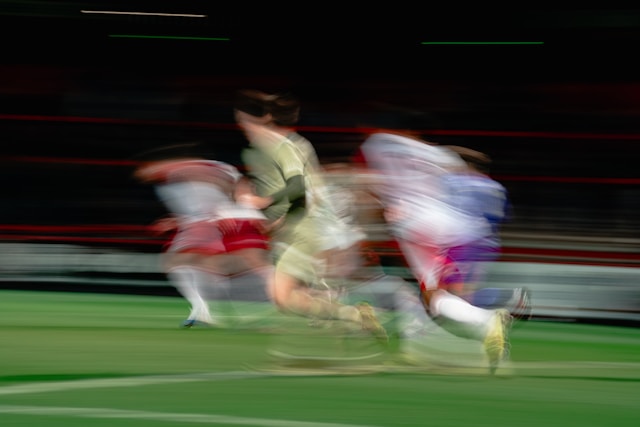
Shutter speed minimums by sport: 1/1000s freezes most field sports. 1/2000s or faster for motorsports and racket sports where racket contact is the key frame. 1/500s works for panning shots where motion blur in the background is intentional — a technique that creates implied speed in ways that a frozen frame sometimes doesn’t.
None of the gear decisions matter if you’re standing in the wrong place. This is where sports photography still separates by human judgment, not processing power.
The best sports photographers know each sport’s geometry well enough to be in position before the action arrives — not chasing it. A basketball photographer who understands pick-and-roll defensive breakdowns positions differently than one who doesn’t. A motorsport photographer who has studied a particular corner’s history knows which apex produces the most spectacular moments. The camera handles focus. The photographer has to handle everything else.
Ethical editing keeps your work credible and professional. Sports photography editing should never alter the truth of the moment. In an era where AI-assisted content manipulation is trivially accessible, this isn’t a reminder — it’s a commercial differentiator. Wire editors, editorial clients, and sports organizations are increasingly requiring C2PA content credentials on submitted work. Your image’s metadata will show what it is.
The best frame from a game is still the one that happened, exactly as it happened, in that one second of light and movement that won’t repeat.
Is the Sony A9 III’s global shutter actually worth the price premium over the A9 II for sports work?
For specific assignment types — yes, unambiguously. The global shutter eliminates rolling shutter distortion entirely, which matters most in three scenarios: motorsports where fast-moving vehicles produce visible skew with a mechanical or electronic rolling shutter; flash sync at any shutter speed up to 1/80,000s, which opens up outdoor fill-flash techniques that were previously impractical; and LED-lit stadiums where the interaction between rolling shutter and lighting cycles created banding artifacts. For outdoor daylight field sports on stadiums without LED lighting issues, the A9 II with AI firmware updates gets within about 10% of the A9 III’s performance at meaningfully lower cost. Know your assignment type before making the investment case.
How do I manage CFexpress Type B card costs sustainably when shooting 20fps continuously?
The buffer management strategy matters more than card speed above a certain threshold. A ProGrade Digital CFexpress Type B Gold 1TB card at roughly $300 handles sustained write speeds that match the Z8 and R5 Mark II’s buffers comfortably. The real cost control is shooting discipline — using burst mode selectively for peak-action sequences rather than holding the shutter down for full minutes at a time. A well-timed 3-second burst at 20fps generates 60 frames. An undisciplined 90-second hold generates 1,800 frames, most of which are identical. AI culling tools recover some of that time in post, but training yourself to shoot shorter, targeted bursts reduces both card wear and culling time simultaneously.
My clients are demanding same-night delivery. How do I build a field editing station that doesn’t compromise image quality?
The setup that works reliably: a 14-inch laptop — current MacBook Pro M4 Pro or Lenovo ThinkPad X1 Carbon — paired with a LaCie Rugged SSD for buffer offload, Lightroom Classic with a preset locked for that venue’s lighting conditions, and a mobile hotspot with a primary and backup LTE connection from different carriers. Build the export preset before the game, not during it. Size the export at 2400px on the long edge at 85 JPEG quality — this hits under 2MB per file and transfers quickly without visible quality loss at web resolution. Practice the full workflow — card offload, cull, edit, export, FTP — at home until the entire process from 200 selects to delivered gallery takes under 25 minutes. That’s achievable. It just takes rehearsing the steps when you’re not exhausted and under deadline.
How should I position myself differently now that AI autofocus handles tracking reliably?
Counterintuitively, better autofocus should push you toward harder positions, not safer ones. The shots from directly behind the goal net, at court level on the baseline, or from an extreme low angle at trackside — positions that were previously difficult to execute because manual focus or early AI AF couldn’t keep up — are now technically executable. The creative problem has shifted from “can the camera track this?” to “does this position tell a better story than the one everyone else is shooting from?” Wire photographers and agency shooters are converging on the same high-percentage positions with essentially identical gear. Differentiation now comes from the positions they’re not covering, which are increasingly the positions that AI autofocus has made newly accessible.
