
Donec efficitur, ligula ut lacinia
viverra, lorem lacus.
Donec efficitur, ligula ut lacinia
viverra, lorem lacus.
There’s a moment that every tintype photographer knows — the one where a client sees their portrait for the first time and goes completely quiet. Not the polite pause before saying something nice. Actually quiet. That silence is the whole point, and it’s becoming harder to manufacture any other way.
In 2026, with AI-generated imagery flooding every platform and hyper-retouched portraits becoming the baseline expectation, a growing number of photographers and their clients are reaching for something that a diffusion model categorically cannot produce: a unique physical object, made from light and chemistry on a piece of blackened iron, that will still exist in 150 years.
Tintype photography — technically called the wet plate collodion process — is experiencing one of the most meaningful revivals in the history of alternative photography. And it’s not nostalgia driving it.
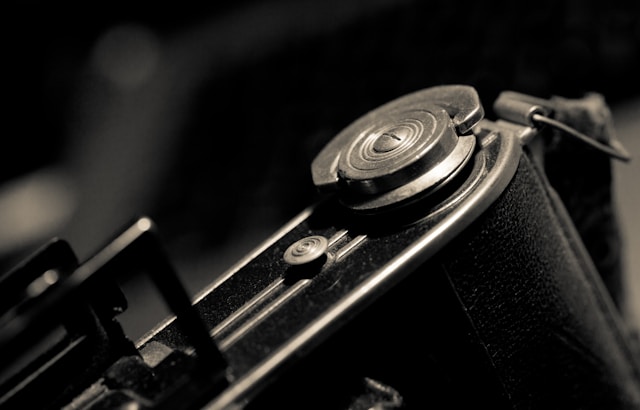
The process was introduced in 1853 by Adolphe Alexandre Martin in Paris. A tintype, also known as a melanotype or ferrotype, is a photograph made by creating a direct positive on a thin sheet of metal coated with a dark lacquer or enamel, used as the support for the photographic emulsion. Despite the name, no actual tin is involved — the substrate is iron.
The process begins by pouring iodized collodion — a transparent solution of nitrocellulose, diethyl ether, and alcohol with iodide or bromide salts added — onto a metal plate. The collodion itself is not light-sensitive. Sensitivity comes in the next step, when the coated plate is immersed in a silver nitrate solution, where a reaction forms light-sensitive silver halides.
From there, the plate goes straight into the camera — still wet. You have roughly ten minutes, maybe twelve if the temperature is right and the humidity cooperates. Expose. Pull the plate. Develop immediately in pyrogallic acid. Fix with sodium thiosulfate. The image either appears or it doesn’t.
If you blinked, you blinked. There is no reviewing a screen, no deleting, no trying again. One plate, one exposure, one object. That’s the product.
This is where most photographers underestimate the process — they think the difficulty is in the chemistry. It is, but only at first. The harder discipline is learning to work without the safety net of instant review. Your exposure instincts have to be right, your focus has to be right, and your subject has to hold the expression you want for the full duration of the exposure, which can run several seconds in lower light conditions. Digital photography made that muscle atrophy. Wet plate forces you to rebuild it.
The broader community of wet plate photographers is small and tight-knit. That’s not a weakness — it functions more like a guild, where knowledge passes through direct apprenticeship rather than YouTube tutorials. Kansas City photographer Megan Karson, profiled in April 2026, describes driving from Kansas City to California to spend a full week apprenticing under a photographer who had been working in tintype for decades. “If you want to do tintype photography,” she says, “you should pay someone for their time to teach you.”
That ethos runs through the whole community. Suppliers like UV Photographics provide chemistry to wet plate photographers across the country. Modern Tintype in Los Angeles offers workshops in collaboration with Brian Cuyler of UV Photographics, with sessions scheduled through 2026. Organizations like the Penumbra Foundation in New York have run wet plate instruction for years, drawing students who want to understand the medium from the substrate up — not just follow a recipe.
The learning curve is steep. There are four separate chemistry sets to manage: the collodion, the silver bath, the developer, and the fixer. Each has its own variables. Silver bath concentration degrades after repeated use and requires periodic clearing. Collodion formulas vary — the ratio of iodide to bromide affects tonal range and image density. Some practitioners add cadmium bromide; others use potassium bromide and accept a slightly different tonal response. Iodide gives speed and density, while bromide expands the tonal scale and color sensitivity — but the absolute amount of halides and their relative proportions cannot be fixed in stone. Ambient temperature changes everything.
Anyone who tells you it’s simple is either very good or hasn’t made enough plates yet.
“You can’t recreate the aesthetic of a tintype with a digital photo in Photoshop,” says Sean Peeler, a California photographer and college instructor who has focused on tintype portraiture since turning his practice toward outdoor wet plate work. He’s right — and the reason is structural, not stylistic.
The image sits directly on the iron substrate, not on paper or glass. The dark backing makes the thin negative read as a positive; the lighter areas are silver, the shadows are the plate showing through. This reversal of normal photographic logic produces a quality of light in the highlights that no inkjet print or backlit screen can approximate. It looks three-dimensional. It looks like it was illuminated from inside.
Each tintype is a unique, one-of-a-kind plate that cannot be reproduced in the way that multiple prints can be made from a single negative. That’s not a selling point in a brochure. It’s a material fact with real consequences: this object, when you hand it to someone, is the only one. Lose it and it’s gone.
The collodion process also renders color differently than modern panchromatic film. It’s orthochromatic — sensitive primarily to blue and ultraviolet light, blind to red. Blue eyes photograph pale, nearly white. Red lips go dark. Fair skin with blue eyes looks luminous; darker skin tones require different exposure calibration. These aren’t flaws. They’re characteristics that define the medium’s visual identity, the same way grain defines a Kodak Tri-X 400 negative or Velvia’s color saturation defines slide film.
As photography enters 2026, the industry is undergoing a quiet but meaningful shift. After a long period shaped by highly polished aesthetics, algorithm-influenced visuals, and a growing push toward AI-assisted perfection, photographers and clients alike are craving something more human.
Tintype sits at the far end of that spectrum. There is no AI involved. There is no undo. The photographer’s skill, the subject’s presence, the chemistry, the light — all of it collapses into a single irreversible moment on a piece of iron.
Clients often come to tintype photographers during life transitions and milestones. “My mom just died, and I want to remember this moment,” or they’re about to have surgery and want a photo of themselves before. These aren’t casual portrait sessions. People arriving for a tintype sitting understand, on some level, that they’re commissioning something permanent — something that will outlast them, the way Civil War soldiers’ tintypes outlasted the men in them.
That weight is part of the medium. The session slows down. The subject sits differently when they know there are no retakes. Something real tends to happen in front of a large-format camera loaded with a wet plate, because everyone in the room understands the stakes.
Running a tintype practice in 2026 is not cheap. The process requires a portable darkroom — Karson typically sets up in the back of her car. Large-format cameras capable of handling 8×10 inch or larger plates run into the thousands of dollars on the used market. Silver nitrate has fluctuated in price considerably over the past few years. The chemistry produces hazardous waste that requires proper disposal. And the ISO equivalent of wet plate collodion sits somewhere around ISO 1 to ISO 4 — meaning you need a lot of light, a very still subject, or very long exposures.
Studio work is more controllable. Outdoor sessions — what Peeler calls mobile tintype — demand understanding of how bright overcast light versus direct sun affects exposure, and how a cloud passing overhead in the middle of an exposure ruins the plate. Peeler’s mobile studio is, in part, a necessity to achieve his creative vision of working outdoors near water, grass, and trees. The inconvenience is the point.
Workshops are proliferating, and that’s a good development — but attend one before purchasing any equipment. The common mistake is buying a camera and chemistry supplies after watching a few videos and then losing an entire silver bath because a procedural error contaminated it. A contaminated silver bath doesn’t announce itself immediately. It reveals itself in the next twenty plates.
The tangible nature of tintype taps into something personal — a connection to a time when photographs lived in albums, were handled, were passed down. In a world where most images exist as files stored on servers controlled by companies that may not exist in twenty years, a tintype has a different kind of permanence. It degrades slowly, over generations. It doesn’t need a password.
That’s not sentiment talking. That’s materials science. Iron coated with lacquer and collodion, stored reasonably well, lasts centuries. The Library of Congress holds tintypes from the 1860s that are sharper than most JPEGs being created right now.
In 2026, photography is fragmenting — faster capture, AI editing, vertical video, algorithmic distribution. Tintype sits completely outside that system. No algorithm recommends it. No app simulates it. The photographers drawn to it tend to be people who are done looking for a faster workflow and have started asking what they actually want to make.
The answer, for a growing number of them, is one perfect plate.
