
Donec efficitur, ligula ut lacinia
viverra, lorem lacus.
Donec efficitur, ligula ut lacinia
viverra, lorem lacus.
Food photography is one of those disciplines where the gap between “technically correct” and “actually appetizing” is enormous — and almost entirely explained by light. Not gear. Not expensive props. Not a $200 marble backdrop tile from Amazon. Get the light wrong and no amount of post-processing recovers it. Get it right, and a bowl of oatmeal on a $12 plywood board can look like a magazine spread.
This guide goes through the full process: window light setup, angles by dish type, styling tricks that professional food photographers actually use, gear that matters vs. gear that doesn’t, and what shifts when you’re shooting restaurant menus commercially rather than personal projects.
Flash is the enemy. Not because flash can’t be used on food — technically it can — but because on-camera flash destroys the texture and depth that make food look edible. The flat front-lighting flattens everything: sauce looks like paint, the texture of a crust disappears, and every highlight blows before the camera even has a chance to render color accurately. Hard, direct light is the technical term for what flash creates, and it’s the right approach for certain editorial or fashion contexts. Food photography is not one of them.
What you want instead is a large, diffuse light source that wraps around the subject without killing the shadows entirely.
Window light setup. North-facing window, no direct sun. Position your shooting surface 2–4 feet from the glass — close enough to get usable light levels at ISO 100–200, far enough that the light isn’t still hard from proximity. The window acts as a softbox roughly the size of a wall. Nothing you buy replicates that.
If the window is south or west-facing and direct sun is hitting the subject, a sheer curtain or a piece of diffusion fabric taped to the glass knocks the light quality from “harsh” to “workable.” It reduces output, so bump ISO or lengthen shutter if you’re on a tripod.
Backlight. Position the food between you and the window, shooting toward the light. This is the setup that makes sauces glow, gives translucency to drinks, makes steam visible (more on that shortly), and adds what food photographers call “rim light” — a bright edge on the back of a dish that separates it from the background. It looks dramatic. It’s also the setup most beginners avoid because facing a light source feels wrong. Try it once and it won’t feel wrong anymore.
Side light. Light coming from the left or right at roughly 90 degrees to the camera axis. Creates directional shadows that reveal texture — the crust of a bread loaf, the grill marks on a steak, the individual seeds on a bun. More dramatic than backlight in terms of shadow depth. This is the direction to use for the dark and moody look.
The reflector. Whatever side of the subject is facing away from the window will fall into shadow. A piece of white foam core — the kind from any art supply store, about $3 — propped opposite the window bounces some light back into that shadow. How much you bounce is an aesthetic choice: less fill = more drama, more fill = cleaner and brighter. Move it in and out until the shadow depth looks like the food rather than a silhouette.
Understanding how shadows behave and what they contribute to the mood of a shot is worth its own study — our piece on shadows in photography covers the technical and creative side in more depth.
This is the decision most beginners don’t consciously make. They put the camera wherever feels comfortable and shoot. The camera angle is actually one of the three or four most important decisions in a food photo, because different angles reveal different things about the same subject.
Overhead / flat lay (90 degrees, straight down). Works best for: pizza, salads, grain bowls, charcuterie boards, flat bread, anything where the arrangement across the surface is the subject. The whole layout is visible, which is why this angle is common for “abundance” shots and styled spreads. What it hides: height, layers, texture on vertical surfaces. A burger shot from overhead is just a bun. A bowl of ramen from overhead loses the depth of the broth.
45-degree angle. The most versatile angle for most dishes. You see the top of the food and some of the front — height is visible, texture is readable, depth is implied. Works for pasta, soup, desserts, anything plated. This is the default starting point for most commercial menu work because it reads quickly and translates well at small sizes (think thumbnail on a delivery app). Adjust the angle up or down a few degrees depending on the height of the dish: taller items benefit from a slightly lower angle.
Eye level (0 degrees, camera parallel to the table). Absolute best for: layered cakes, cocktails, stacked burgers, tall glasses, anything where the layers or height ARE the story. Shot from eye level, a three-layer cake shows each layer clearly. Shot from above, it’s a circle. This angle requires a clean, uncluttered background behind the food because there’s nothing to shoot past — whatever is directly behind the dish ends up in the frame.
One decision that trips people up: don’t split the difference. A 20-degree angle gives you neither the clean top view of overhead nor the strong depth read of 45 degrees. Commit to one direction. Halfway angles tend to look like accidents rather than choices.
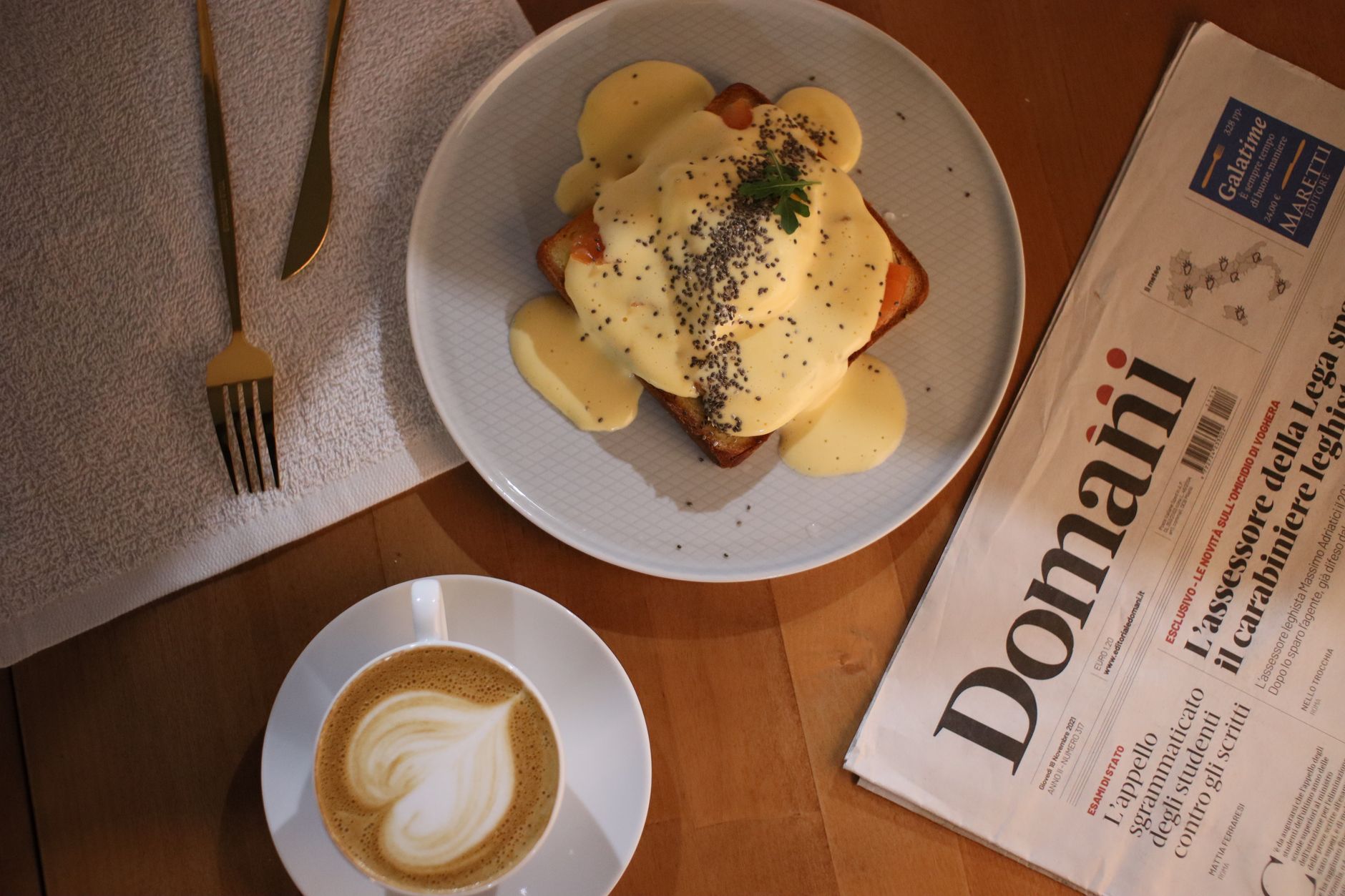
Composition in food photography follows the same foundational principles as any other genre — but applied to a very specific subject. The rule of thirds is the standard starting framework: place the main subject at one of the four intersection points rather than dead center. A bowl of soup in the center of a frame feels static. The same bowl placed one-third from the left, with empty space to the right, creates tension and visual movement.
Negative space. More is usually more. The most common mistake in beginner food photography is filling the entire frame with props, garnishes, ingredients, and surfaces until the actual dish gets lost. Empty space is not wasted space — it’s where the eye rests and where the subject reads most clearly. A dark background with one well-lit bowl of pasta and 40% of the frame left empty will outperform a frame stuffed with every prop from your kitchen.
Leading lines. Cutlery, a folded napkin, the edge of a wooden board, a sprig of herbs — anything with a directional quality can pull the eye through the frame toward the main subject. This is the food photography application of foreground elements: a fork positioned in the near foreground not only adds context but creates depth and a visual path into the image.
Emphasis and the hero element. Every food photo should have one clear main subject, and every other element in the frame should support rather than compete with it. The sharpest focus, the best light, the most prominent position — all of that belongs to the hero dish. Secondary props should be slightly soft, slightly dimmer, and positioned around rather than in front of the main subject. The full framework for creating visual hierarchy in a frame is covered in our post on emphasis in photography.
Fill vs. breathe. There’s a version of food photography where the frame is full and generous — think a charcuterie board spilling slightly off-edge, imperfect but abundant. And there’s a version where everything is spare and deliberate — one small plate, lots of negative space, surgical precision. Both work. The mistake is mixing them in the same shoot or the same gallery. Choose a direction.
This is the part that separates food photography from snapshots. The food doesn’t just need to taste good — it needs to hold together visually for the duration of a shoot, which is longer than anyone expects.
Steam. Fresh food produces steam for about 90 seconds after plating. After that, it’s gone. If steam is part of the shot (soup, coffee, fresh pasta), your window is narrow. For longer shoots, there are two workarounds: wet cotton balls microwaved until steaming, placed just out of frame; or dry ice chips placed in a small container near the dish. The cotton trick is cheaper and easier. The dry ice is more controllable.
Fake ice. Real ice melts. A drink styled with real ice looks perfect for approximately two minutes before the glass starts sweating and the ice shrinks. Acrylic ice cubes — available at any restaurant supply store, around $20–30 for a set — photograph identically to real ice, don’t melt, and don’t cause condensation issues. Use them for any shot where a cold drink needs to hold for more than three minutes.
Shine on meat. Cooked meat dries out quickly under lights and on camera. Glycerin mixed with water (about 1:3 ratio) sprayed lightly onto the surface of a steak or roast adds sheen without changing the appearance of the food. A brush of neutral cooking oil works in a pinch but leaves more of a visible coat.
Burger architecture. The ingredients slide. The lettuce wilts. The bun compresses under the weight of everything above it. The fix: toothpicks through the center of the stack, removed digitally later (or cropped out), to hold the layers in position. For the lettuce, an ice water bath immediately before shooting keeps it crisp for 10–15 minutes. The cross-section is what makes a burger look good — take the time to build it intentionally rather than just stacking and shooting.
Berries and fruit. Cold water mist applied immediately before shooting is usually enough. For shoots that run long, a thin coat of vaseline adds shine and slows surface drying, though it changes the texture slightly. Fresh mint and herbs wilt fast — keep them in ice water between shots and add to the plate at the last second.
Sauce drips. Controlled sauce drips — on the side of a cake, on a burger bun, on a dessert — look intentional and styled in a way that random drips don’t. Use a small squeeze bottle with a narrow tip to place the drip exactly where you want it. Practice on a spare plate first. The drip needs enough viscosity to hang rather than run — if it runs immediately, chill the sauce slightly before applying.
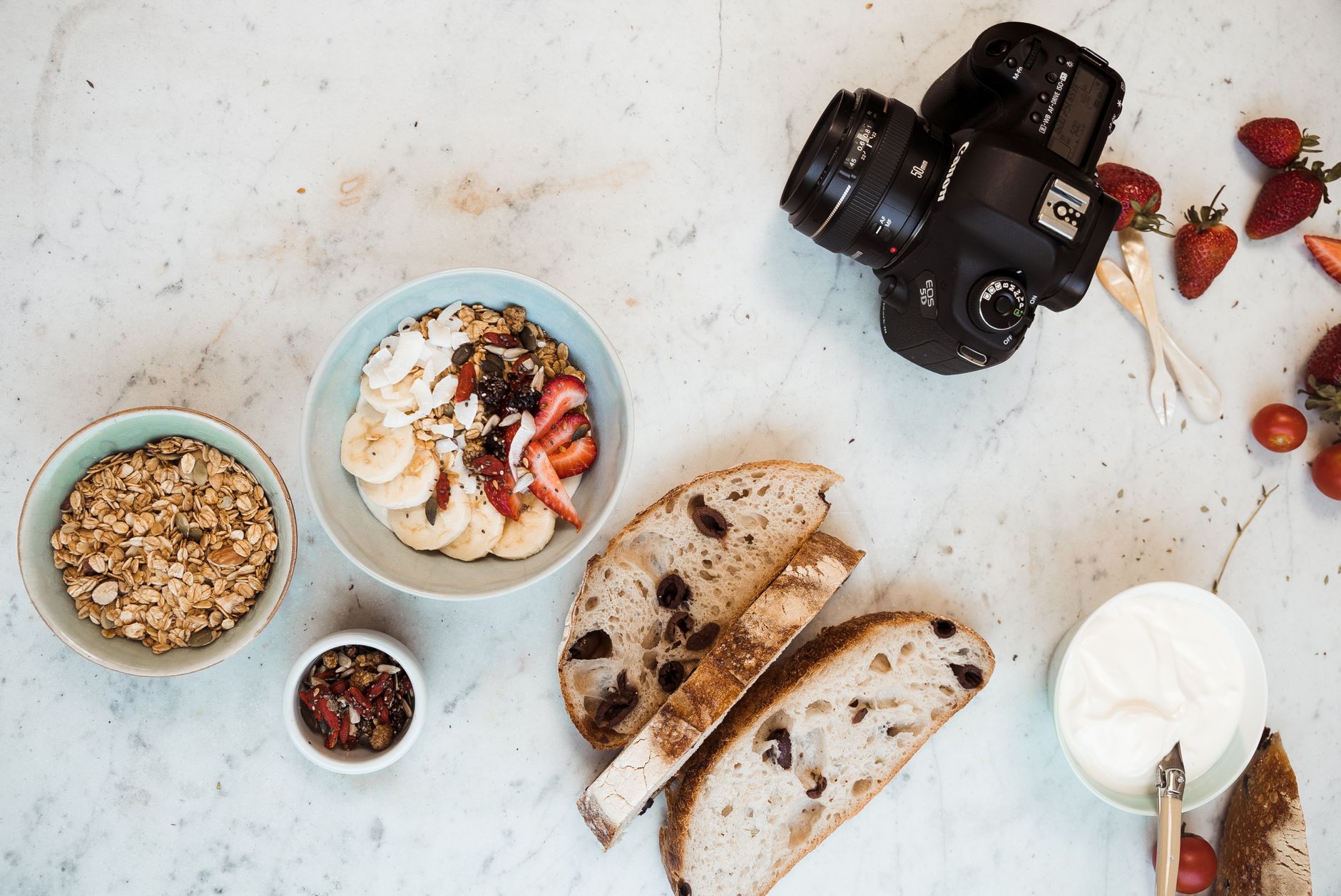
Wood. The most forgiving and versatile food photography surface. Weathered, lighter wood reads bright and natural; darker, more textured wood reads rustic and rich. Actual wooden boards are better than vinyl wood-look backgrounds — the real texture catches light differently and photographs more convincingly at close range.
Marble. Good for overhead shots with food that has strong visual contrast (dark coffee on white marble, colorful bowls against a light background). It’s overused in certain aesthetics, but it’s overused because it works. The visual noise of marble veining can compete with detailed dishes, so save it for simpler plating.
Dark slate or painted boards. The foundation of the dark and moody approach. Dark matte surfaces absorb light rather than reflecting it, which deepens shadows and creates the rich, dramatic look associated with restaurant-quality food photography. A painted board — flat black or dark charcoal, matte finish, $8 of paint on a $5 piece of MDF — does the same job as a $60 specialty backdrop.
Props. The decision about what to put in the frame around the food should answer one question: does this tell a story about the food, or does it just fill space? A bread knife next to a loaf tells a story. A stack of vintage books next to a bowl of cereal fills space. Raw ingredients related to the dish (whole spices near a curry, a lemon wedge near a cocktail) work because they’re contextually honest. Unrelated decorative objects usually don’t.
One thing worth saying directly: buy fewer, better props. Five well-chosen pieces — two textile surfaces, a couple of plates, a piece of cutlery — go further than a drawer full of random objects you’ll never use together coherently.
The lens: 50mm f/1.8. The answer to most gear questions about food photography. Wide enough for environmental shots, tight enough for close work, and the rendering at f/2.8–f/4.0 gives you the depth you want without either blurring the entire dish or making everything equally sharp. The 50mm on a crop sensor (which becomes roughly a 75mm equivalent) is particularly well-suited to the 45-degree angle for plated dishes.
For extreme close-ups — condensation droplets on a glass, sesame seeds, the cross-section of a cut fig — a dedicated macro lens (Canon 100mm f/2.8L, Nikon 105mm f/2.8G, Sony FE 90mm f/2.8 Macro) gives you sharpness at close focus distances that a standard 50mm can’t match.
Tripod: not optional. Shooting hand-held at the slow shutter speeds required for window light at ISO 100–200 produces blur. A tripod also forces you to make deliberate compositional decisions rather than constantly adjusting and reframing. Ball head, not a pan-tilt head — you want to be able to reposition quickly.
Camera settings:
Smartphone. Yes, you can shoot food on a phone. The rear camera on current flagship phones — iPhone 16 Pro, Pixel 9 Pro — produces files that are commercially usable for web and social media. The limitations: you can’t shoot into the light effectively because the small sensor struggles with flare, and portrait mode (simulated depth of field) often misidentifies the dish’s edge, creating blurry areas mid-plate that look like a processing error. For phone shooting: use the grid overlay, set exposure manually by touching and holding in the camera app (or use ProCamera / Halide for more control), shoot at the main rear camera rather than ultra-wide or telephoto, and get on a small gorillapod or table tripod for the slower shutter speeds window light requires.
The two dominant aesthetics in food photography are distinct enough that they start from different color grading approaches.
Bright and airy: lifted shadows (the blacks should never go fully black), cool-neutral highlights, high white point, clean whites in the background. The feel is fresh, clean, approachable — good for breakfast content, healthy food, light dishes. In Lightroom: lift the blacks to +20–30, pull highlights down slightly, add a small positive value to whites, keep the tone curve gentle with a slight S but nothing aggressive. Cooler color temperature (5000–5300K in post) keeps the white surfaces from going warm-yellow.
Dark and moody: deep shadows with genuine blacks, warm highlights (often orange-amber), rich texture. Good for pasta, meat dishes, baked goods, cocktails — anything that benefits from looking rich and indulgent. In Lightroom: drop the blacks, add contrast via the tone curve, warm the highlights using the HSL panel (increase orange and yellow luminosity slightly), pull back whites to keep highlight areas from blowing. Texture and clarity sliders are more useful here — they add visible grain and surface detail that the bright-and-airy approach would suppress.
Color correction before grading: food has specific color requirements. Red meat should actually look red. Green herbs should look green, not yellow-green or olive. The HSL panel is the tool: isolate the specific hue range of the problem color and adjust saturation and luminosity separately. Yellow and orange affect warm foods (cheese, toast, pastry); green and yellow-green affect vegetables and herbs; red and orange affect meat and tomatoes.
Snapseed and VSCO are both capable tools for phone-shot food work. Snapseed’s selective tool lets you brighten or add texture to a specific area of the image without affecting the whole frame — useful for brightening a dark area of a dish without blowing the background. VSCO’s film presets work as starting points for the moody look without requiring manual HSL work.

Everything above applies to personal projects and food blogging. Commercial restaurant work — menu photography, website imagery, delivery app listings — has one additional constraint that changes the whole approach. Speed.
A plated dish holds for about three minutes before it starts showing wear: wilting, heat distortion, sauce seeping into surfaces, condensation appearing in wrong places. In a studio setting with full prep time and a food stylist, you can set up indefinitely because the food isn’t real until the shoot starts. In a restaurant kitchen, you’re working with actual food, freshly plated, and your shot window is the time between “chef says it’s ready” and “this no longer looks like the dish we want to sell.”
The practical workflow: set up the shot before the food arrives. Establish your light, your angle, your composition using a placeholder plate or stand-in dish. When the actual plate comes out, you place it in the pre-positioned spot and shoot immediately. No adjusting the setup after plating. That step — building the shot in advance around an empty space — is the difference between consistently getting usable images and consistently scrambling.
For menu consistency: same lighting direction, same angle category, same background surface, same rough framing for every dish in the same category. Menus and delivery apps need visual coherence — a mix of overhead shots, 45-degree shots, and eye-level shots for a single menu section looks like three different photographers shot it. Establish a system and hold to it across the whole shoot.
Asheville has a dining scene that rewards this kind of attention. Restaurants throughout the city are increasingly treating food photography as a direct revenue driver — delivery platforms report that menu items with professional photography receive significantly more orders than the same items without images. If you’re a restaurant owner or manager reading this: the cost of a half-day menu shoot recovers itself faster than most marketing spend.
For booking commercial food photography in the Asheville area, reach out through the contact page — we can talk through what a menu or brand shoot looks like in practice.
Before you start:
FAQ
What is the best lighting for food photography?
Soft, diffuse natural light from a window, positioned to the side or behind the subject. A north-facing window is ideal. Sheer curtain if the light is direct. White foam core as a fill reflector on the opposite side.
What’s the best angle for food photography?
Depends on the dish. Overhead for flat, spread-out foods (pizza, salads, boards). 45 degrees for most plated meals. Eye level for height — stacked items, cocktails, layer cakes. Pick the angle that shows what’s interesting about the specific dish, not the angle you find comfortable.
Can you shoot food photography on a phone?
Yes, for social media and web use. Use the main rear camera, manual exposure control, and a small tripod. Avoid portrait mode for food — the edge detection creates blurry artifacts mid-dish that look like technical failures.
What’s the difference between bright & airy and dark & moody food photography?
Different light direction, different background choice, and entirely different editing approaches. Bright and airy uses soft front or side light, white/light backgrounds, lifted shadows. Dark and moody uses raking sidelight, dark matte surfaces, deep shadows. They’re not interchangeable as aesthetics — pick one per project and be consistent.
Do I need expensive gear to start?
A 50mm f/1.8 (around $100–125 used), a tripod, and a window is a complete kit. Everything beyond that — macro lens, dedicated lighting, multiple backdrop surfaces — adds capability but doesn’t compensate for understanding light and composition. Start with the window, learn what it does, and build from there.
