
Donec efficitur, ligula ut lacinia
viverra, lorem lacus.
Donec efficitur, ligula ut lacinia
viverra, lorem lacus.
There’s a narrow window where the belly is round enough to be unmistakably pregnant, the subject still moves comfortably, and the energy in the room is anticipation rather than exhaustion. Most photographers who specialize in this work will tell you the same thing: get in that window, and even technically average shots come out strong. Miss it, and you’re fighting the session the whole way through.
This guide covers the full picture — timing, what to wear, how to pose, where to shoot, and what to do when it isn’t coming together. Posing and clothing are covered together on purpose, because they’re not separate decisions. What someone wears determines which poses read well on camera. Choosing them independently is how you end up with a technically correct pose that looks stiff in the final image.
Book earlier, and the belly might not have enough projection to be the clear subject in the frame. Book later, and comfort becomes a real constraint — long sessions on your feet, certain positions becoming genuinely difficult, and a subject who’s mentally and physically done with being pregnant.
At 28–34 weeks, all three conditions are right: the belly is fully pronounced, movement is still relatively easy, and most clients are still in a headspace where they want to celebrate rather than just survive. That window is the target.
The exception is multiples. With twins or triplets, the belly reaches full-term proportions earlier — schedule at 24–28 weeks. Waiting until 32 weeks with a twin pregnancy is the equivalent of shooting a singleton at 38 weeks. Technically possible, practically miserable for everyone.
When to book: during the second trimester, targeting the session for weeks 30–32 with some flexibility either direction. Don’t leave it until 28 weeks to reach out — most photographers who do consistent maternity work are booked 6–8 weeks out.
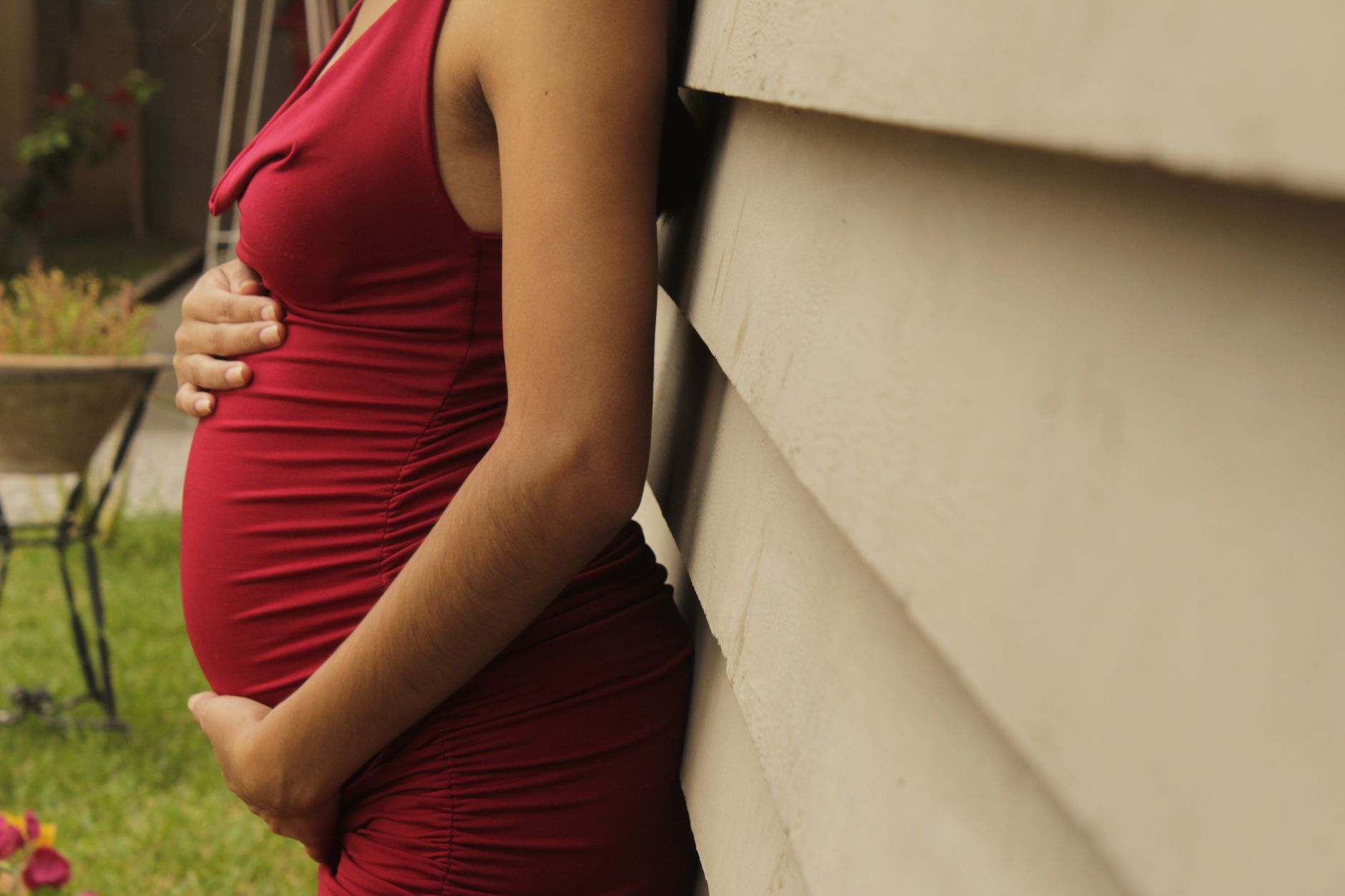
This is where most guides split the topic in two and weaken both. Clothing choice and posing are the same decision. Here’s why.
Fitted jersey or stretch fabric shows the belly’s actual shape without adding visual bulk. In a profile or S-curve pose — hips shifted, torso slightly turned — this reads as a clean, sculptural silhouette. The belly becomes the clear subject. Put the same subject in a loose tunic, and the same pose loses its shape entirely. The fabric fills the space where the curve should be.
Flowing chiffon or silk moves in the frame and adds a softness that jersey doesn’t. It works in walking shots, in outdoor sessions with any wind, in lying-down shots where the fabric pools around the subject. It’s not as revealing as jersey, which can be useful for clients who want the belly documented but aren’t comfortable with completely fitted clothing. PinkBlush, Seraphine, and BHLDN all make session-ready gowns in this category — worth having a few in your studio if you do consistent maternity work.
What doesn’t work: busy patterns and horizontal stripes. Patterns interrupt the silhouette at exactly the point you want the eye to move — around the belly. Horizontal stripes add apparent width to the torso. Both are technically fine in casual photos; neither belongs in a posed maternity session unless the client is very attached to them, in which case the conversation is worth having before the day.
Color: neutral and muted tones — dusty rose, sage, cream, terracotta — photograph better than saturated primaries in most natural light setups. They also age better. Dark solids (navy, black, charcoal) elongate the torso and work particularly well for clients who are self-conscious about weight gain outside the belly.
Partner coordination: matching isn’t the goal. Tonal harmony is. If she’s in a dusty sage gown, he should be in a complementary neutral — beige linen, grey, cream — not in a matching sage shirt. Identical colors make the couple look like they’re in a coordinated costume. Complementary tones make them look like they thought about it without being precious.
The double chin question comes up constantly. The angle solves it, not the clothing — but tight necklines and high collars make it worse by shortening the visual line of the neck. Off-shoulder or V-neck cuts give the neck room. Shoot from slightly above eye level when doing close-up portraits. Ask the subject to bring the chin slightly forward and down rather than tilting the head up toward the light. More on how angle and positioning eliminate this in any portrait context — the same mechanics apply here.
The body’s natural shape at 7–8 months pregnancy is a strong composition by itself. The goal of posing is not to impose a shape — it’s to find the angle where that shape reads best in two dimensions.
The S-curve foundation. Shift the weight onto the back foot. Let the front hip drop slightly. Turn the torso 45 degrees from camera rather than straight-on. From this position, the belly projects forward, the spine curves naturally, and the silhouette has the continuous S-shape that reads as graceful in a photograph. From there, you have options: arms at sides, hands on hips, hands cradling the belly. All three read differently, and it’s worth cycling through them.
Belly cradle. Hands cupping the underside of the bump. Not placed stiffly on top — the hands should look like they’re actually supporting something, which they are. This is the most common maternity pose for a reason. It works with jersey, it works with gowns, it works outdoors and in studio. The risk is it becomes mechanical if you just place the hands and move on. The natural version happens when the subject is actually thinking about the baby — give them a moment to settle into it before you shoot.
Profile. Straight side-on to camera, slight weight shift to the back foot. The belly’s projection is most visible from a true profile. Shoot tight enough that the belly fills a significant portion of the frame — if it’s a small element in a wide shot, the profile loses its impact. For close-up profile work, the 85mm range gives you working distance without distortion.
Lying down. Subject on their side on a fabric-covered surface or grass, top leg slightly bent forward, head propped on hand or resting on arm. The belly rounds naturally against the ground. Shoot from roughly the subject’s eye level or slightly above — not from standing height, which makes the pose read as a documentation rather than a portrait. A stretch of textured fabric underneath changes the whole register of the image.
Detail shots. Close in on the belly with hands framing it — both her hands, her hands and partner’s, or just the belly against a neutral background. At this distance, fabric texture and skin tone become the whole composition. A 50mm stopped down to f/4 keeps a bit more of the belly in focus than wide-open at f/1.8, which can feel unintentionally soft on something this close.
This is where the session either builds into something emotionally real or stays technically correct but flat.
With a partner: start with structure, then leave room. Place them — he behind, arms around the belly from behind; or face-to-face with foreheads touching; or him slightly behind and to the side with one hand on the belly. Once the physical positions are set, stop directing and wait. The moment where someone looks down at the belly, or where eyes close and foreheads press together a little harder — that’s not directed. That’s what you wait for.
Height difference is worth solving before the session, not during. If one partner is significantly taller, have them seated or on different levels rather than both standing, which creates an awkward tilt toward the shorter person.
Face-to-face poses work better when both partners have something natural to do with their hands — on the belly, on shoulders, interlaced. Hands hanging at sides in a face-to-face pose is the most common thing I see in maternity shots that almost worked. Give the hands somewhere to be.
With siblings: do these early — the first 15–20 minutes of the session. A 4-year-old’s patience for a photo session has a hard ceiling, and that ceiling arrives faster than you think. Keep sibling setups simple: seated together, older child with hands on the belly, the whole family standing with child between parents. Don’t try to engineer a complex pose involving a young child and a client who’s 32 weeks pregnant and can’t move quickly.
The shots where older children are kissing the belly, or whispering to it, or pressing an ear against it — those work because they’re genuine interactions. They happen when you ask the child “do you want to say hi to the baby?” not when you place them in a scripted position and tell them to kiss. The same principle behind how natural family moments get captured in a family session applies here: give people something to do or interact with, not something to perform.
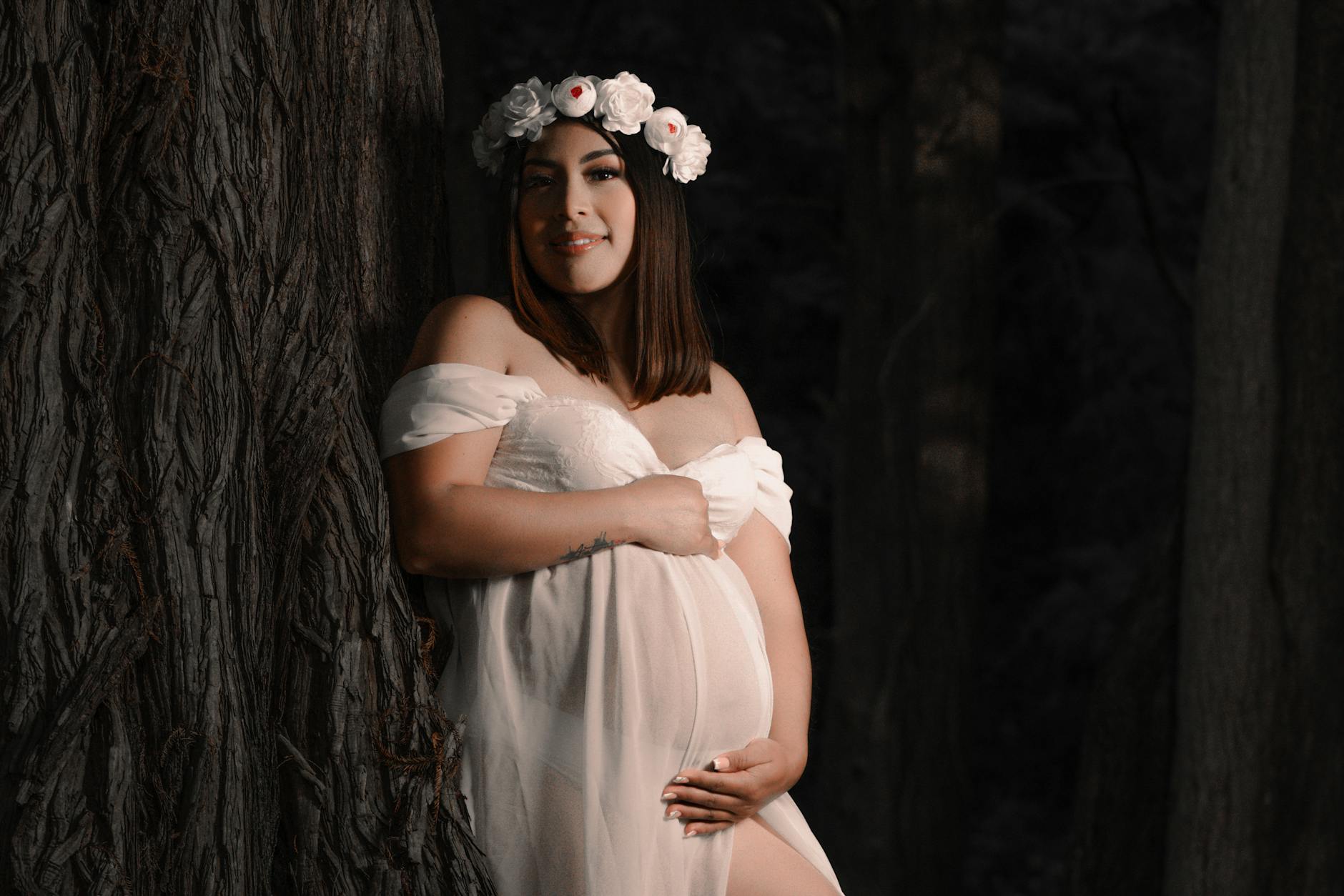
This isn’t an either/or. They produce different images that serve different purposes, and knowing which one fits the client is part of the consultation.
Studio gives you control: consistent light, no weather variables, no wind in the chiffon at the wrong moment. For clients who want clean, elevated portraits — strong silhouettes against neutral backdrops, controlled shadows, editorial look — studio is the better choice. You can also shoot in cold seasons without the client standing outside in January in a sleeveless gown. The trade-off is that studio images require more posing and directing work; there’s no environmental context to carry the image when the pose doesn’t land. For thinking through backdrop options in a studio context, the portrait background guide lays out what actually works versus what just photographs as a middle-grey void.
Outdoor at golden hour — 30–60 minutes before sunset — gives you the warm backlight that turns chiffon translucent and fills shadows with a color that’s genuinely difficult to replicate in studio. Fields, meadows, or forested areas with a clear western view are the standard setup. Expose for the face, let the background go warm. f/2.0–f/2.8 at 1/500 sec keeps motion out of the frame; bump ISO to 400–800 if you need the light.
Beach works well mid-morning when the angle of light is still low enough to be flattering. Midday beach light is harsh and creates shadows under the eyes and bump that are unflattering regardless of posing.
Winter outdoor sessions are underutilized in maternity work. The quality of light in winter — low, directional, with the kind of cool-warm contrast you can’t get in summer — is genuinely beautiful. The challenge is client comfort, which is solvable with practical planning: a warm coat between setups, a dedicated changing space nearby, keeping the session length shorter. The location and styling thinking from winter engagement sessions translates almost directly — the light behaves the same way.
On studio lighting specifically: for indoor maternity work, a large softbox or octabox at roughly 45 degrees produces soft shadows that flatter the rounded form of a pregnant belly. The exact same modifier placement used in loop lighting for portrait work — light source slightly above eye level, positioned to one side — works well here. The belly becomes the forward element that catches the most light, which is exactly where you want the emphasis.
Florals and fabric. A stretch of linen, silk, or velvet under or around the subject adds texture and warmth to studio setups. Florals — whether a bouquet in the hands, a floral arch overhead, or loose petals on the ground — create context without requiring elaborate set builds. They’re also flexible: the same flowers read differently against a neutral studio backdrop versus a meadow background.
Milk bath maternity. Water at 90–92°F (warm enough to be comfortable without risk), shallow — typically 8–12 inches of fill. Petals, eucalyptus, or botanicals floating on the surface. Subject seated or partially reclining. Shoot from above or at a slight angle; the reflective surface adds dimension that’s difficult to get any other way. Lighting challenge: harsh light creates unwanted reflections on the water. A large diffused source placed off to one side, or shooting near a window with indirect light, keeps the surface readable rather than blown out.
Boudoir maternity occupies a specific space — more intimate, more personal, typically shot in lingerie or wrapped fabric with emphasis on the subject’s strength and femininity rather than the documentary element. The conversation in the boudoir photography guide about client preparation and building comfort in the session applies directly here. The reason boudoir maternity sessions work when they work is not the lighting or the wardrobe — it’s that the subject feels safe enough to be present rather than performing.
What doesn’t need to be a theme: chalkboard signs, gender reveal props, elaborate rustic setups with mason jars and burlap. Clients who want these should have them. But none of it adds to the actual photograph of a person at this specific moment in their life. Lead with that, and add props when they serve the image — not the other way around.
Most maternity clients are not experienced portrait subjects. Some are actively self-conscious about their body during pregnancy, even if they’re excited about the session. The technical setup can be perfect and the images still feel posed and stiff if there’s nothing driving the expression.
Prompts that tend to work:
For solo shots: “Don’t look at me — look down at your belly and just think for a second.” Wait. That 3-second window of genuine inward attention photographs differently than any directed expression.
For couples: “Tell them something about the baby — something you’re actually looking forward to.” The response and the reaction are both usable. You don’t need both partners looking at camera.
For physicality: “You’re going to walk toward me, slowly — just talk to each other.” Walking shots break the static feeling that builds up in studio sessions and create movement in a body that’s been holding positions for 30 minutes.
For the double chin concern specifically: don’t tell the subject to “lift their chin” — this usually makes it worse by creating neck tension. Instead: “Bring your nose toward the window” or “look at the corner of the room.” Directional language moves the whole head naturally rather than isolating the chin.
What to avoid saying: “Relax.” Nobody has ever relaxed in response to being told to relax. Instead, create the condition for relaxation — give them something to look at, something to do, or something to talk about — and then photograph what happens.
Timing the conversation: the best time to reach you about a maternity session is before 24 weeks. By 28 weeks, the scheduling window for prime dates narrows quickly. If a client contacts you at 30 weeks wanting to shoot at 32, it’s doable — but they should know they’re working with fewer options.
Session length: 1.5–2 hours for a full maternity session is realistic. Long enough for multiple looks and locations within a session, short enough that a 30-weeks-pregnant client doesn’t end up exhausted. If you’re including partner and sibling setups, budget the extra 20–30 minutes before the standalone poses.
US market pricing:
What to tell clients before the session:
For session booking and package details, the contact page has everything you need to get started.
How many weeks pregnant should I be for maternity photos?
28–34 weeks for most clients. Multiples: 24–28 weeks. The belly should be round and clearly projected, and you should still be able to move comfortably and stand for extended periods. After 36 weeks, both of those conditions become harder to meet.
What if I don’t love how I look pregnant?
This comes up more than people expect, and it’s worth being honest about: the posing, angles, and clothing choices in this guide are specifically designed around what photographs well on a pregnant body, not around what society tends to show as the idealized version. A client who’s uncomfortable doesn’t need reassurance that they “look amazing” — they need a photographer who knows what angles to use and what fabric choices actually work. That’s a technical problem with a technical solution.
Is outdoor or studio better?
Depends on the client and the time of year. Studio is more controlled and works year-round. Outdoor golden-hour sessions have a particular quality of light that’s genuinely hard to replicate in studio. If you can only do one: for the cleanest, most timeless images, studio. For something with more atmosphere and movement, outdoor.
What comes after a maternity session?
For many clients, the natural next step is a newborn session — typically scheduled during pregnancy, with the session itself at 5–14 days after birth. The two sets of images together tell the before-and-after story in a way that either one alone doesn’t. Our full guide to newborn photography covers everything from poses and safety to what to expect from the session.
