
Donec efficitur, ligula ut lacinia
viverra, lorem lacus.
Donec efficitur, ligula ut lacinia
viverra, lorem lacus.
Henri Cartier-Bresson shot Paris with a 50mm lens, a rangefinder, and no autofocus. The decisive moment didn’t require 40fps pre-capture buffers. That’s not a nostalgic observation — it’s the practical reminder that street photography’s core problem has never been technical. The technical problems have largely been solved. What hasn’t been solved is the harder one: being in the right place, reading a scene fast enough to act, and having something worth saying about what you found.
That’s still the job in 2026. Everything else is infrastructure.
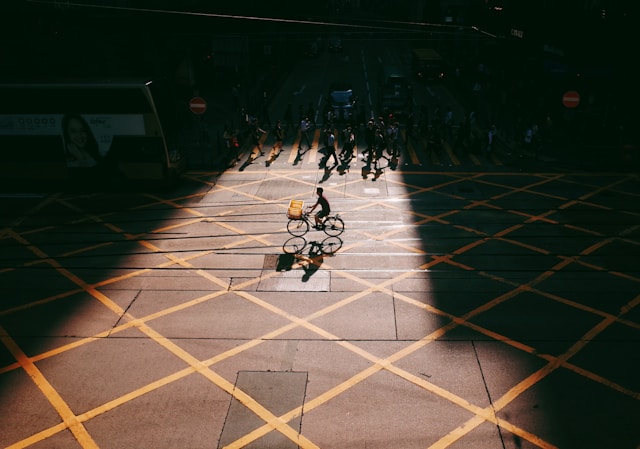
“In 2026, photography moves away from overly controlled, flawless imagery toward moments that feel raw, intimate, and real. Imperfection becomes a feature — not a flaw.” That shift is felt in street photography more directly than in almost any other genre, because street work was already operating in that register. The market is catching up to what the genre always knew.
What’s rising to the top in 2026 is work that feels intentional — whether it is raw and unpolished or highly produced. Audiences and curators are more visually literate than ever. They’ve seen the perfect skin, the unreal skies, the cinematic presets slapped onto every file. Street photography sits in an interesting position here. An image that looks spontaneous but was actually composed carefully doesn’t read as fraudulent — it reads as skilled. The distinction between “authentic” and “honest” is worth sitting with.
Direct flash photography is back as a deliberate creative choice. Instead of soft, diffused lighting, photographers are using on-camera flash to create hard shadows and bold highlights — a raw, unpolished look that feels immediate and energetic, particularly popular in street photography, where the goal is to capture the atmosphere of a moment rather than beautify it.
Direct flash on a street frame does something specific: it removes the ambient world and replaces it with a flat, shadowless zone around the subject. The subject pops with a kind of emergency clarity. Everybody behind them drops to dark. It’s not subtle, and that’s the point — the 90s party photography aesthetic has arrived in editorial street work and it’s generating actual engagement because it feels like something happened rather than was observed.
This is where most photographers overthink things, spending money on bodies when the limiting factor is technique. That said, certain gear decisions reduce friction in specific ways.
Comparative guides consistently highlight 35mm and 50mm focal lengths for street photography. A two-prime kit with a fixed-lens compact keeps you fast and invisible. The recommended camera setup: Auto ISO with minimum shutter set, silent shutter activated, AF-ON mapped to your thumb.
The Fujifilm X100VI earns its reputation in street photography for a specific reason: it looks like a consumer camera. Nobody in a coffee shop reacts to it the way they react to a mirrorless body with a 70–200mm mounted. The fixed 23mm f/2 lens (35mm equivalent) produces a field of view that captures context and subject simultaneously — the environmental frame that gives a street portrait meaning without requiring you to back up 20 meters. The leaf shutter synchronizes with flash at any speed, including 1/4000s, which allows fill-flash in direct sunlight without an ND filter.
The Ricoh GR IIIx offers a 40mm equivalent in a body that fits in a jacket pocket — genuinely, not “with the right jacket.” The GR series has been the quiet favorite of documentary and street photographers for years precisely because it disappears. Pull it out, shoot, pocket it. Nobody processes it as a photography interaction. The 40mm equivalent is slightly tighter than the classic 35mm street focal length, which forces you to be closer — closer produces better frames, because proximity collapses the psychological distance between the viewer and the subject.
For photographers who want autofocus tracking in a small body, the Sony ZV-E10 II or the Fujifilm X-T50 cover street work with animal and person detection that locks fast in low light. But tracking AF in street photography is mostly irrelevant — you’re not chasing subjects, you’re anticipating them. Zone focus at f/8 and a set distance of 2.5 meters is faster than any AF system on a subject that appears and moves in two seconds. The technique predates autofocus because it works.
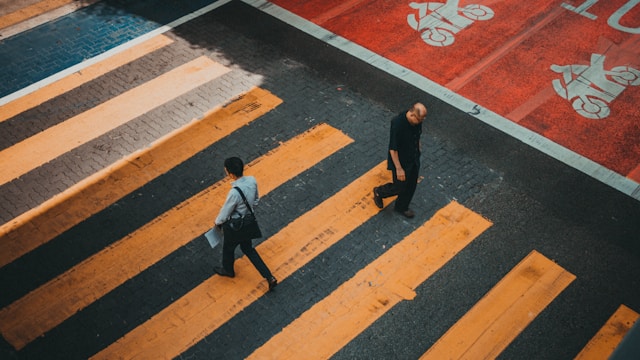
The photographers consistently producing strong street work in 2026 share one habit: they pick a location and stay. Not for 20 minutes — for two hours. They learn the light cycle of a specific corner, the foot traffic patterns, the moments when a shadow falls at the right angle. Then they position themselves and wait.
The core technique remains unchanged: anticipation, not reaction. Pick a background first — graphic light, converging lines, a doorway — then wait for the right subject to walk into the frame. Zone focus to react instantly when AF would hesitate.
This is what “the decisive moment” actually means in operational terms. Not reflexes. Preparation. Cartier-Bresson didn’t sprint through Paris randomly firing. He found the scene, understood the geometry, and waited. The shutter timing was the last step, not the defining one.
The most competitive images in 2026 share a common trait: intentionality. Whether raw or polished, vertical or wide, film-grainy or clean — they feel like the photographer meant it. Strong fundamentals — composition, light, timing — combined with a style that feels current and honest puts work ahead of most of what’s being produced.
Layering is the compositional technique worth developing specifically. Foreground element, midground action, background story — three planes of information that reward a second look. It’s harder to produce than a single clean subject on a simple background, but it’s what separates images that stop the scroll from images that appear and disappear in two seconds. The technical challenge: at 35mm and f/8, everything from two meters to infinity is in acceptable focus. You have the depth of field. The work is finding a location where three layers of story coexist naturally.
Street photographers still encounter confusion about this, and confusion causes hesitation, and hesitation kills frames. Worth being precise.
Taking photographs of things plainly visible in public spaces is a constitutional right in the United States — and that includes transportation facilities, the outside of federal buildings, and police and other government officials carrying out their duties. The First Amendment protects the right to photograph law enforcement officers performing their duties in public.
Simply photographing a person in public view — including children and law enforcement officials — does not require a model release or expressed consent in the United States. The requirement for releases applies when using images for commercial purposes: advertisements, stock photography, and promotional materials. Editorial use, portfolio display, gallery sales, and publishing to a personal website or social media does not require consent for images taken in public spaces.
The international picture differs significantly. In France and Germany, publication can require consent or a clear exception even for candid public photography. In South Korea and Hungary, photographing anyone without consent is not permitted. The editorial vs. commercial distinction applies globally: advertising and promotional materials typically require model releases regardless of jurisdiction.
One nuance that catches people: spaces that appear public may not be. Many parks, squares, and sections of city high streets are no longer publicly owned — they’ve been privatized. When a space is privately owned, First Amendment protections don’t apply, and property owners can restrict photography. In practice: if you’re on a named city street or a publicly funded park, you have the legal standing. If you’re in a “public square” adjacent to a corporate headquarters or a privately owned shopping district, the rules may differ. When in doubt, the simple test is whether the space is managed by the city or a private entity.
The confrontation question deserves a direct answer: if someone objects to being photographed, you have no legal obligation to delete the image in most US and UK jurisdictions. But you have to weigh the confrontation against the image. Most street photographers who work consistently describe exactly one productive response to a hostile interaction: lower the camera, make eye contact, explain briefly what you’re doing and why. Most confrontations end there. The ones that don’t escalate require you to know your rights clearly and stay calm — not because arguing is productive, but because clarity about what you’re legally entitled to do ends the conversation faster than apology or aggression.
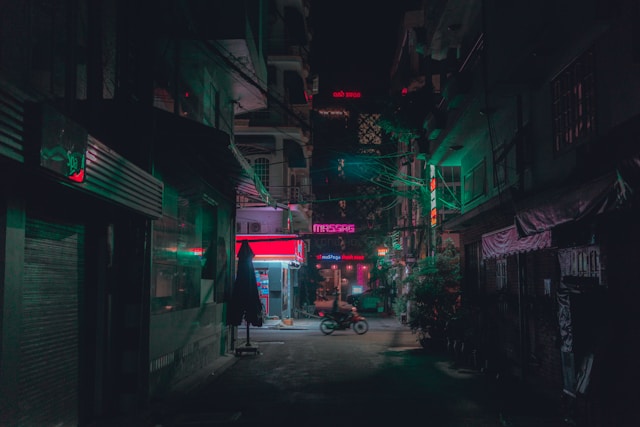
Black and white remains the dominant treatment for street work — not as a cliché, but because color in a complex urban scene fights the subject for attention. A red jacket in the background competes with a face. Desaturate it and the hierarchy clarifies immediately.
Go monochrome when shape, shadow, and gesture are the message. That test is worth applying shot by shot rather than as a blanket policy. Some street frames carry specific color information that defines the mood — the green neon of a late-night convenience store, the warm window light against cold blue shadow. Strip that and you lose the specific sense of time and place. Keep color when it’s doing work. Convert when it’s causing noise.
For the film aesthetic that’s currently performing well: photographers are applying film-inspired grain and muted tones, using retro flash and flash-on candid techniques reminiscent of 90s party shots, and blending vintage elements with modern clarity. The grain level that works is higher than most photographers use — visible at viewing size on a phone screen, not just when you zoom to 100%. Grain below a certain threshold reads as digital noise. Grain above it reads as intentional texture.
Is the Ricoh GR IIIx actually better for street than a mirrorless with a small prime, or is that just community mythology?
It’s not mythology — it’s physics and social psychology working together. The GR IIIx at 40mm equivalent in a pocket-sized body triggers zero recognition response from people on the street. A Sony A7C with a Voigtländer 35mm f/2 is also a small setup, but it looks like a camera. The GR doesn’t. That difference produces different expressions, different levels of awareness, different body language from subjects who might otherwise stiffen slightly. The image quality difference between the two is real — the A7C’s full-frame sensor holds shadows better in low light — but in street photography, a slightly inferior file of a genuine moment beats a technically cleaner file of someone performing naturalness. The GR earns its reputation from results, not marketing.
How do I handle the tension between candid shooting and the ethics of publishing images that subjects clearly wouldn’t want published?
This is the question that separates practitioners who think seriously about the work from those who don’t. The legal answer is clear: in most jurisdictions, a candid image taken in a public space can be published for editorial or artistic purposes without consent. The ethical answer is harder. A practical framework: ask whether the image documents something worth documenting, or whether it exploits a moment of vulnerability primarily for aesthetic effect. A person sleeping rough on a subway is a fact of urban life that street photography has documented for over a century — the image serves a documentary purpose. A person caught in an embarrassing private moment that happened to occur in public is a different calculation. The distinction is intent and use. Work that treats subjects as human beings first and compositional elements second tends to produce images that hold up over time — not just legally, but artistically.
What’s the most effective way to work with direct flash on the street without making subjects feel accosted?
The approach that produces the best results is also the most counter-intuitive: be obvious about it. Walking down a street invisibly and firing an unexpected flash blast at someone produces exactly the confrontational reaction you’d expect. Walking slowly, making occasional eye contact, and occasionally nodding at someone before raising the camera with a small flash unit — the Godox V350S fits the bill at roughly 350g — signals that you’re a photographer working, not someone with a phone doing something sketchy. The flash itself, once subjects see the images on a back screen, often generates curiosity rather than hostility. The hard shadows and direct quality that feels harsh in previews reads as atmospheric drama in the final edit, and most people who see themselves in a direct-flash street portrait react more positively than they expect to. Start in busier locations where foot traffic provides a kind of permission structure — a busy market, a late-night street near bars — before moving to quieter scenes.
How do I build a body of street work that has visual coherence without it looking like I only shoot one location?
The coherence needs to live in your editorial choices, not your geography. A consistent focal length — shooting everything at 35mm equivalent regardless of location — already establishes a consistent sense of proximity and perspective across a body of work. A consistent tonal treatment — the same Lightroom preset or grain structure applied uniformly — creates visual continuity even across images shot in different cities. And a consistent subject preoccupation — the way light interacts with urban architecture, or the specific geometry of crowds, or the relationship between people and commerce — gives the work a point of view that transcends individual images. The photographers with the most coherent street portfolios are recognizable from a single frame before you read their name. That recognition doesn’t come from shooting the same corner repeatedly. It comes from having an eye that operates consistently regardless of where the photographer is standing.
