
Donec efficitur, ligula ut lacinia
viverra, lorem lacus.
Donec efficitur, ligula ut lacinia
viverra, lorem lacus.
Aerial photography used to require a helicopter charter. Now it requires a $760 drone, a Part 107 certificate, and enough flight practice to not bin the aircraft into a tree on your second outing. The barrier dropped so fast that the skill — actually making compelling images from altitude — became the differentiator, not the gear.
This guide covers the full workflow: choosing a drone based on sensor rather than price, understanding US regulations before you ever take off, building the flight skills that make the camera work, and applying composition logic that looks completely different at 200 feet than it does at ground level.
The drone market is full of specs that don’t tell you much: obstacle avoidance sensors, transmission range in kilometers, maximum speed. For photography, the number that matters is sensor size. Larger sensor = more dynamic range, better low-light performance, and more latitude in post. Everything else is secondary.
Under 249g (no FAA registration for recreational use):
The DJI Mini 4 Pro is the current benchmark at this weight class. It has a 1/1.3-inch sensor and an f/1.7 aperture — genuinely capable optics for a sub-250g aircraft. At $760 with RC-N2, it shoots RAW stills, logs D-Log M video, and handles moderate wind. The weight matters because drones under 250g don’t require FAA registration for recreational flight — the design choice is deliberate, and it makes the Mini 4 Pro the default recommendation for anyone starting out.
The older DJI Mini 3 (not Pro) uses a similar sensor but lacks the f/1.7 aperture advantage and has fewer flight modes. Still capable, and available used for $350–400.
Mid-range (registration required for rec, Part 107 required for commercial):
The DJI Air 3 uses a 1/1.3-inch sensor (same class as the Mini 4 Pro) but adds a medium telephoto lens alongside the main wide. For $1,100, the dual-lens setup is genuinely useful — the 3x equivalent telephoto compresses aerial perspectives in ways the wide angle can’t. It weighs 720g, which means FAA registration regardless of use.
Professional:
The DJI Mavic 3 Classic carries a 4/3-inch sensor — the same size used in entry-level interchangeable lens cameras. The dynamic range is substantially better than 1/1.3-inch, and the Hasselblad color science produces files that require less correction work in Lightroom. At $1,570, it’s the entry point for commercial photographers who need their aerial images to match the quality of their ground-level work. This is the drone for real estate photographers billing $300+ per listing and architecture clients with print deliverables.
What to avoid: drones with 1/2.3-inch sensors (common in the budget tier under $400). At base ISO in good light, they’re acceptable. The moment you push shadows in post or shoot in anything but ideal conditions, the noise becomes a problem that can’t be fully corrected.
This section is specific to the United States. Laws change; always verify current FAA rules at faa.gov/uas before your first flight.
FAA registration: Required for any drone 0.55 lbs (250 grams) or heavier. The DJI Mini series is designed under 249g specifically to avoid this threshold for recreational flyers. Registration is $5 and done online at faadronezone.faa.gov.
The Part 107 certificate: Required for any commercial drone operation. “Commercial” means any time money changes hands — shooting real estate listings, charging for aerial photography services, delivering images to a paying client. There are no exemptions for small drones or small transactions. Part 107 is a knowledge test administered at FAA-approved PSI testing centers, costs $175, and the certificate is valid for 24 months. The test covers airspace, weather, regulations, and crew resource management. Most people pass with 10–20 hours of study. The material is available free on the FAA website.
If you plan to add drone services to any photography business — real estate, weddings, landscape, journalism — get the Part 107 first. Offering commercial drone services without it is a federal violation, not a local ordinance issue.
Hobbyist (recreational) requirements: If you fly purely for personal non-commercial purposes, you need to pass the TRUST (The Recreational UAS Safety Test) online — it’s free, takes 20–30 minutes, and produces a certificate you keep on your phone. You also need to register any drone over 250g.
No-fly zones and airspace authorization:
The 400-foot ceiling: Federal maximum altitude is 400 feet AGL for recreational flight, or up to 400 feet above a structure’s highest point when flying within 400 feet of that structure.
This gets skipped. People buy a drone, read about camera settings, and skip directly to shooting. Then they lose footage to jittery stick inputs, or put the drone into a wall while trying to frame a shot and fly at the same time.
The order is: fly comfortably first, then add camera work.
Basic proficiency checklist before shooting:
None of this takes long. Two or three practice sessions in an open field gets most people comfortable with stick control. The value is that when you’re framing a shot later, your brain isn’t simultaneously running the “don’t crash the aircraft” process. That cognitive overhead goes away with muscle memory, and the shots get noticeably smoother.
Cine mode vs. Normal mode: DJI drones have a Cine mode that slows stick response significantly — inputs translate to gentler movements. For video and for capturing smooth still sequences, Cine is the right mode. Normal mode is for transit between locations, not for composition work.
Battery management: 30 minutes of total flight time is optimistic; plan on 20–25 minutes of shooting time. Return to home at 25–30% battery, not 10%. The last 10% is the emergency reserve for unexpected wind, longer return distance than estimated, or a landing area problem. Bring two extra batteries for any serious shoot — one in the aircraft, two warming in a jacket pocket (cold batteries perform poorly).
Wind: Check wind speed at altitude, not just ground level. Windy.com displays wind by altitude layer, which is more accurate than a weather app’s surface reading. Most consumer drones handle up to 20–25 mph (Level 5 in DJI’s Beaufort scale rating), but shooting video above 15 mph produces footage that looks like the drone is fighting the air. Below 10 mph is the comfortable shooting range.
Arrive knowing what you’re going to shoot, not planning to figure it out once airborne. Battery time is short; ad hoc composition in the air wastes both.
Scout on satellite view first. Google Maps or Apple Maps satellite layer shows you the layout from above before you ever get to the location. Look for the patterns that won’t be visible from the ground: agricultural field geometry, road networks, shoreline curves, rooftop arrangements. If you’re shooting real estate, load the address in satellite view and plan your three or four key angles before the client’s appointment.
Golden hour from altitude is different. The low sun angle that produces flattering light at ground level also creates long, dramatic shadows from above — tree shadows extend across fields, building shadows create geometric patterns on pavement, topography becomes legible. Early morning is often better than evening for aerial work because haze builds through the day (especially in humid climates like the Southeast). If both times are possible, fly at dawn.
Seasonal considerations in WNC: Spring and fall offer the most photogenic aerial conditions in the mountains — the tree canopy color in October is worth planning an entire trip around, and the clarity of spring air before summer humidity sets in is a practical advantage. Summer foliage is dense and uniform, which can work against landscape aerials. Winter offers dramatic snow coverage but shorter battery performance in cold.
Most drone cameras have limited or fixed aperture, which changes the exposure control options compared to ground-level photography.
ISO: 100–200 for stills in daylight. There’s no reason to push ISO when the sun is out and you’re using a fast shutter to freeze motion. Higher ISO is a noise source you can avoid entirely in good light. Some DJI cameras have an Extended ISO (50 on the Mavic 3 series) that’s worth using on bright days to protect highlights.
Shutter speed: For still photography from a hovering drone in calm conditions, 1/500 sec is a reasonable minimum — it eliminates any micro-vibration from the motors and keeps horizon lines sharp. Faster is fine. 1/1000 in bright sun at ISO 100 is clean.
For video, the standard is the 180-degree rule: shutter speed should be approximately twice the frame rate. At 24fps, that’s 1/50 sec. At 30fps, that’s 1/60 sec. This produces natural-looking motion blur in moving footage. At ISO 100 in full sun, those shutter speeds require ND filters — and that’s exactly what they’re for.
ND filters: Essential for video in bright conditions. A set of ND4, ND8, ND16, ND64, and ND256 covers the range from overcast to direct sun at midday. The ND64 or ND128 handles bright sun at ISO 100 while maintaining the 180-degree shutter angle. Polar Pro and Freewell both make well-regarded sets for DJI drones at $60–120 per set.
White balance: manual. The same logic as any other photography — auto white balance shifts between shots and creates color inconsistency across a sequence. Set to 5500K for daylight, 6500K for overcast or shade-heavy scenes, and leave it.
RAW format + JPEG. Shoot RAW+JPG. The JPEG gives you a quick-review file to evaluate on location; the RAW is what you edit from. Aerial scenes often have large dynamic range — bright sky, dark shadows in buildings or trees — and the RAW latitude for recovering highlights and shadows is substantial compared to a baked JPEG.
D-Log M / D-Cinelike for video: These are flat, low-contrast picture profiles that preserve dynamic range by not applying contrast in-camera. They look washed out until you apply a LUT (Look-Up Table) or grade the footage in post. For anything going to client delivery or anywhere color accuracy matters — use it.
The fundamental principles of composition don’t disappear from a drone. The rule of thirds applies to horizon placement and subject positioning regardless of how high the camera is. But some patterns only become visible — or only become interesting — from altitude.
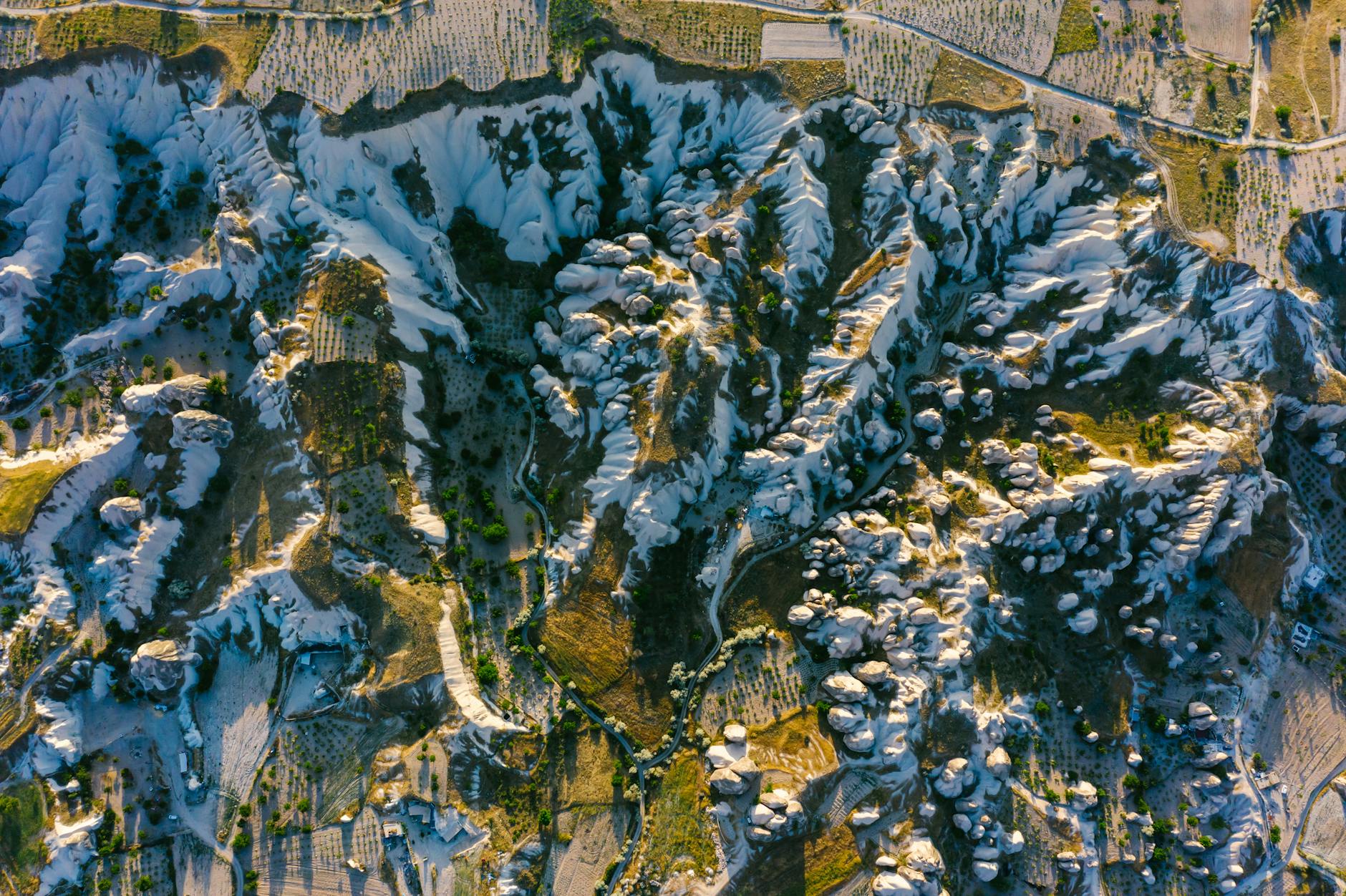
Top-down / bird’s-eye. The straight-down 90-degree angle eliminates depth cues entirely. The frame becomes graphic — shapes, patterns, color blocks. This works powerfully for: agricultural fields (concentric tractor lines, crop circles, irrigation patterns), parking lots full of similarly-colored cars, marinas with boats arranged in parallel, swimming pools embedded in property layouts. It’s the angle where aerial photography is most distinctly different from any ground-level equivalent.
Low-altitude oblique. 30–60 degrees down angle, 50–150 feet altitude. Shows context — the property and its relationship to the street, the mountain and its relationship to the valley below it. This is the workhorse angle for real estate and landscape. It reads immediately and requires the least compositional interpretation from the viewer.
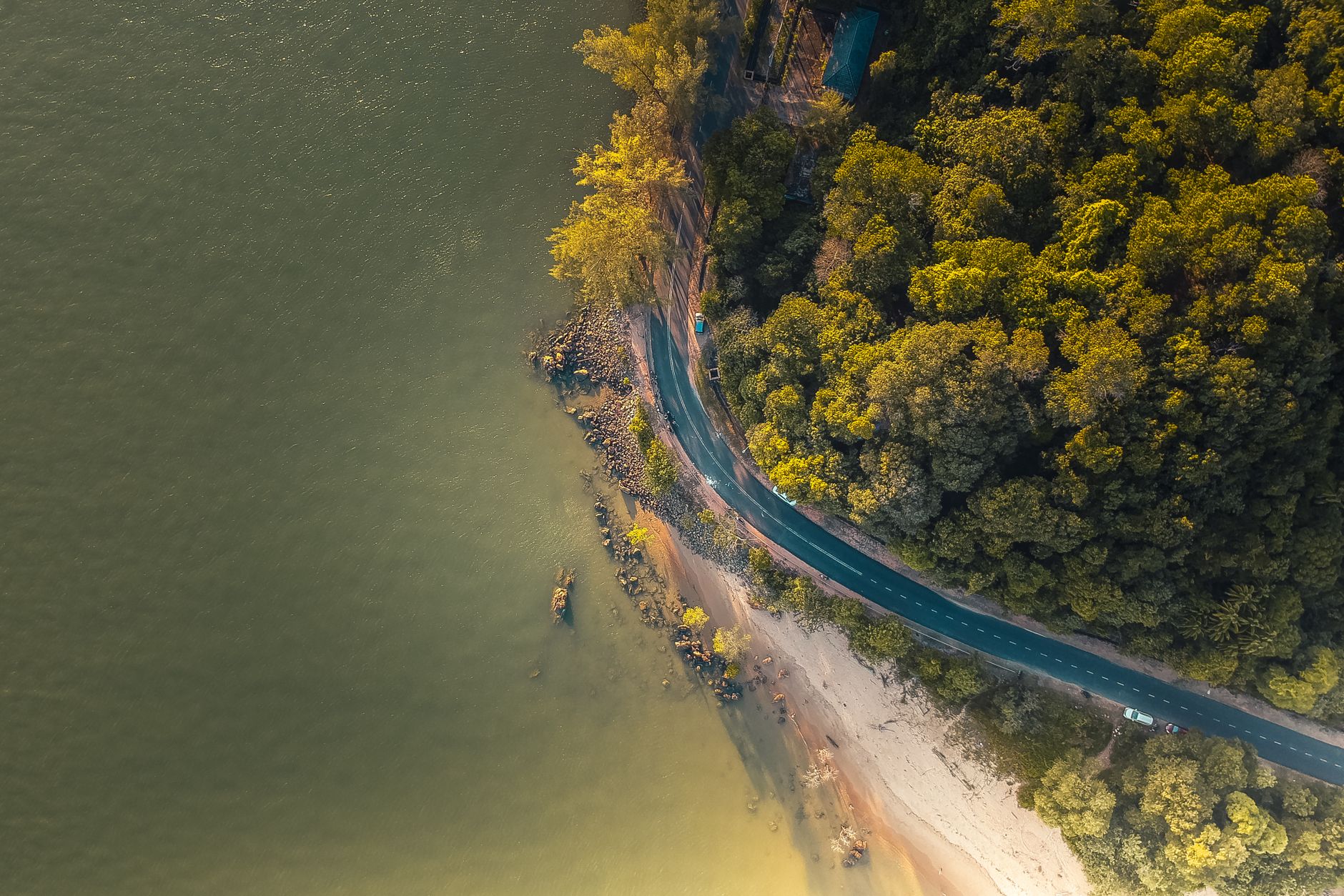
Leading lines from above. Roads, rivers, shorelines, fences, rows of trees — from altitude, these become graphic directional elements that pull the eye through the frame. A coastal highway from 300 feet that curves from the foreground toward a promontory in the distance is a different composition than the same road photographed from the shoulder. The elevated perspective turns a mundane element into a structural component.
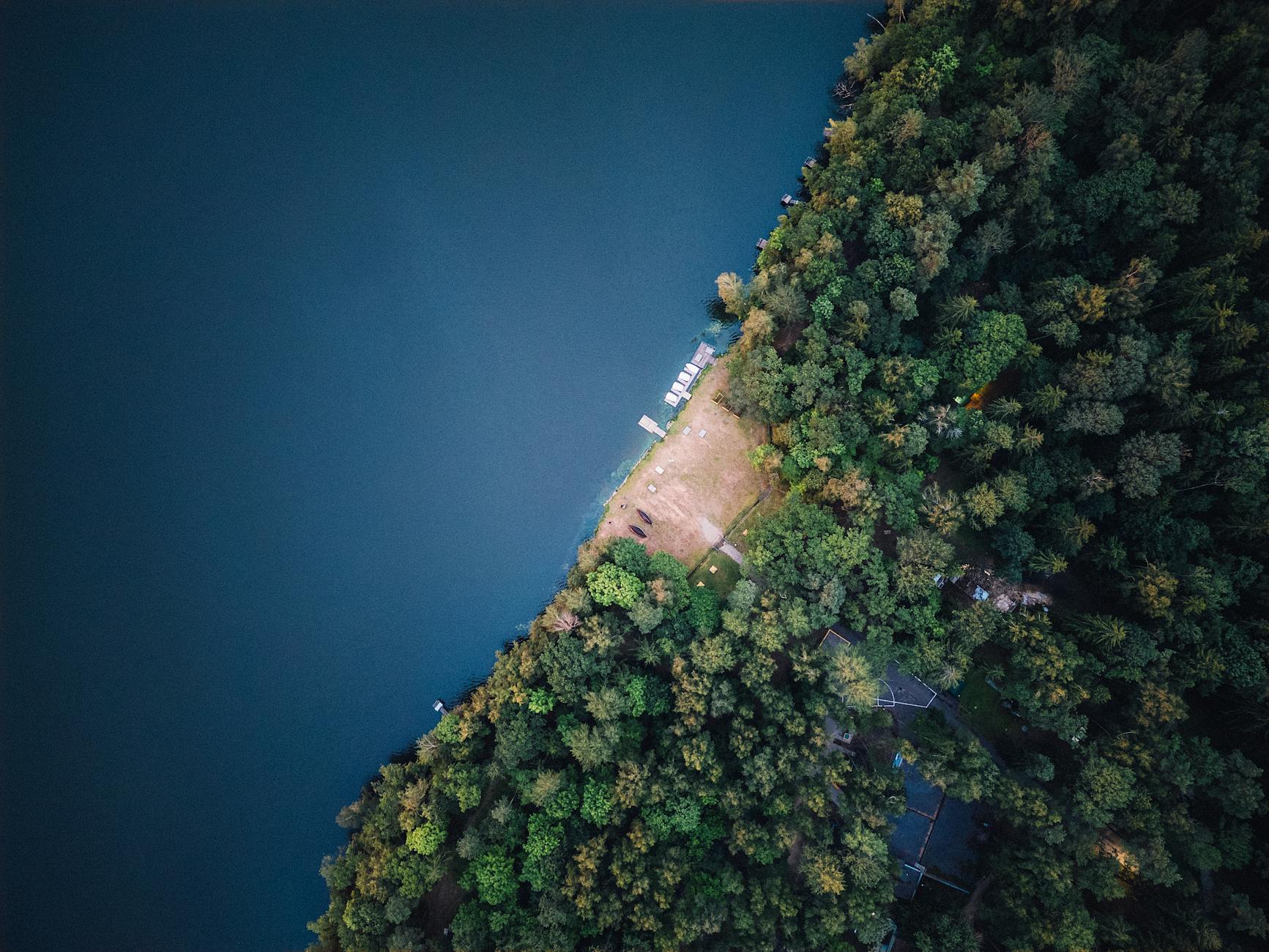
Scale. Including a person in an aerial frame immediately establishes the size of everything around them. A kayak on a lake at 200 feet tells you the scale of the lake. A person standing at the edge of a cliff face tells you the height. Without that reference, altitude shots can look like textures rather than places. The deliberate inclusion of scale elements — a person, a car, a boat — is one of the clearest markers of experienced aerial composition versus the standard top-down texture shot.
Symmetry and patterns. Architecture, particularly historic and civic architecture, often reveals bilateral symmetry from directly above that’s invisible at ground level. A courthouse, a stadium, a large estate — straight overhead, the geometry becomes the subject. The same applies to natural patterns: river deltas, coastline rock formations, snow coverage.
The landscape photography guide covers how horizon placement, foreground weight, and the relationship between sky and ground scale at ground level — the same spatial thinking applies to aerial work, just rotated. Your “foreground” from altitude is what’s closest to the camera in the frame, which is now below the aircraft rather than in front of it.
Real estate aerial photography is where most commercial drone work starts, and it’s a direct upsell to any existing real estate photography service. A listing that already includes interior and exterior stills benefits from three or four drone perspectives that show the lot, the roof condition, the neighborhood context, and the property’s relationship to nearby features — water, parks, urban center.
The real estate photography guide covers the current state of listing image expectations and where professional photography fits into the transaction. Drone work fits as a premium addition to that package, not a replacement for ground-level content.
Standard aerial listing content:
Pricing: $100–200 as a drone add-on to a standard listing package is the current market range in most mid-size US markets. In high-demand markets (coastal, luxury segment), $200–400 is defensible. The FAA Part 107 requirement is non-negotiable — operating commercially without it exposes both the photographer and the client to federal liability.
Insurance: commercial drone operators should carry liability coverage for unmanned aircraft. VSPOT, BWI Aviation Insurance, and Global Aerospace all offer UAS-specific policies. Some standard photography business policies exclude UAS work explicitly — verify with your carrier.
Technical considerations specific to real estate:
Dehaze. The single most useful adjustment for aerial photography. Atmospheric haze builds with altitude and distance; even on clear days, images at 200 feet have more haze than ground-level shots. The Dehaze slider in Lightroom (or Clarity’s cousin in Capture One) cuts through it and restores contrast and color saturation that the haze was suppressing. +20 to +40 is a useful starting range; more and the image starts looking HDR-processed.
Highlight recovery. Aerial scenes almost always include a bright sky that’s significantly brighter than the ground. Pull highlights to -40 or -60 before evaluating overall exposure. If you shot the ground correctly exposed, the sky will blow; if you exposed for the sky, the ground is dark. RAW latitude handles most of the recovery. For scenes where it can’t — very bright sky against dark shadow — graduated filters in Lightroom or sky masking with the AI Select Sky tool let you treat sky and ground independently.
Color correction for drone-specific color casts. Images at altitude pick up atmospheric color differently than ground-level shots — blues and cyans skew more strongly, especially in the shadow regions. The HSL panel adjusted on the Blue and Cyan channels (pull saturation down 10–15, adjust hue toward a cleaner neutral) corrects the common aerial color cast without affecting the rest of the image.
Video: LUT workflow. D-Log M footage needs a LUT applied before any other grading adjustments. DJI provides free D-Log M LUTs on their website. In DaVinci Resolve: apply the LUT to the node first, then grade from there. In Premiere Pro: use the Lumetri Color panel with the LUT loaded in the Creative tab. Start there and adjust rather than trying to grade D-Log footage freehand.
Do you need a license to fly a drone?
For recreational (non-paid) flying with a drone under 250g: no license, but you do need to pass the free TRUST online test and follow FAA recreational rules. For any paid commercial work — including real estate photography — you need the FAA Part 107 Remote Pilot Certificate, which requires passing a knowledge test ($175, at PSI testing centers). Drones over 250g also require FAA registration regardless of use.
What’s the best beginner drone?
The DJI Mini 4 Pro at $760. It comes in under the 250g registration threshold for recreational flight, has a capable 1/1.3-inch sensor, shoots RAW, and the flight handling is forgiving enough for new pilots. The DJI Mini 3 (not Pro) is a cheaper option around $470 if the budget is firm.
What settings should I use?
For stills in daylight: ISO 100, RAW format, manual white balance at 5500K, shutter 1/500 or faster, expose to protect highlights. For video: enable D-Log M profile, apply ND filter to maintain 180-degree shutter angle (shutter = 2 × framerate), manual white balance. Both: Cine mode for smoother stick response.
Can I fly near Asheville or in the WNC mountains?
Parts of the Blue Ridge Parkway corridor are NPS-managed land where drones are prohibited without a permit — this covers much of the parkway between Asheville and the NC/TN border. The Great Smoky Mountains National Park is entirely no-fly. Pisgah National Forest (USFS land, not NPS) operates under different rules but has specific restrictions in some zones. Always check B4UFLY and verify land management jurisdiction before flying in the WNC backcountry. Doing this homework before every flight in this region is not optional — the overlap between NPS, USFS, and private land is complex enough that a location that looks clear on a map may not be.
How much does drone photography add to a real estate listing?
Typically $100–200 added to a standard listing package for stills and a short video clip. Premium markets and larger properties support higher rates. The key is Part 107 certification — real estate drone work without it is commercial operation without a license.
