
Donec efficitur, ligula ut lacinia
viverra, lorem lacus.
Donec efficitur, ligula ut lacinia
viverra, lorem lacus.
Remove the leading lines from most iconic landscape photographs and what’s left is a collection of shapes sitting in a frame. Add them back and the image has movement, depth, and a reason for the eye to travel. Leading lines are the oldest compositional tool in visual art, predating the camera by millennia — and they work in photographs for the same reason they worked in Renaissance paintings and in ancient mosaics: the brain follows lines. It can’t help it.
Understanding how to find, create, and control them changes how you approach any scene with a camera.
A leading line is any element in a photograph that guides the viewer’s eye in a specific direction. The guidance doesn’t require a literal line — a continuous physical element from one point to another. It requires the perception of direction. A row of fence posts, a line of people, a sequence of lamp posts — the eye reads the implied trajectory and follows it.
The psychological mechanism is borrowed from how we navigate space. In the real world, a path, a road, a river, or a corridor tells us where movement is possible. We orient to it instinctively. In a two-dimensional photograph, that same spatial signaling creates the illusion of depth — the eye perceives the image as having dimension, not just surface.
This is why leading lines are particularly powerful in photography and less immediately necessary in sculpture: a photo is inherently flat. Every tool that suggests three-dimensionality — perspective, shadows, depth of field, layered foreground and background — works against that flatness. Leading lines are among the most efficient of those tools because they can suggest distance across the full length of the frame in a single element.
The visual effect is felt even when the viewer couldn’t articulate why. A photograph with a strong leading line feels like it has somewhere to go. A photograph without one often feels like it’s just sitting there.
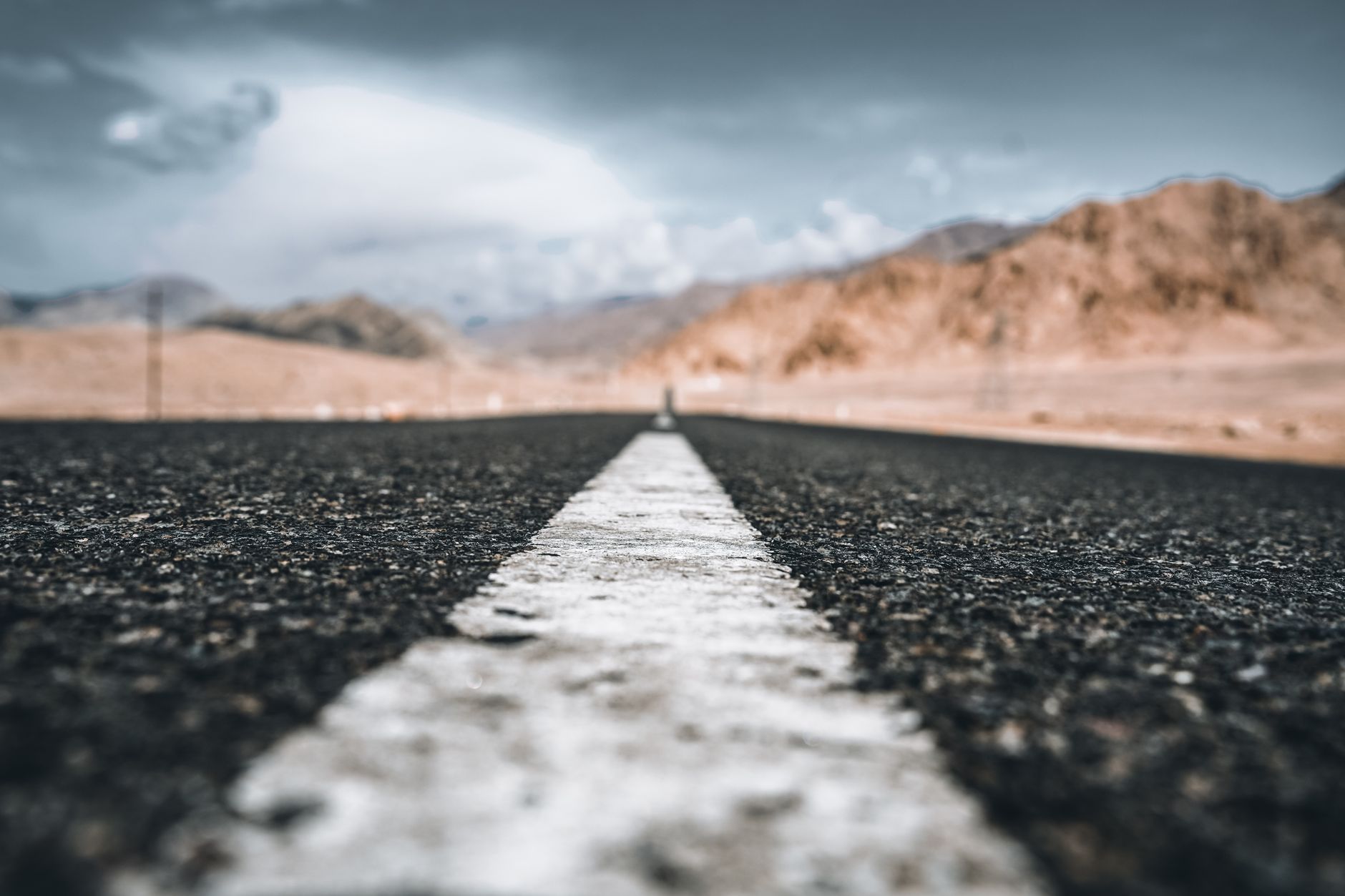
Straight lines. Horizontal, vertical, or diagonal. Each carries different visual energy.
Horizontal lines feel stable and calm — the horizon at sea, a flat desert road stretching to the edge of the frame. The eye rests on them. They work well when the emotional register of the image is meant to be peaceful or expansive.
Vertical lines communicate height and authority — the face of a cliff, a line of tall buildings shot from street level, a stand of old-growth timber. They resist the natural left-to-right reading direction of the eye and ask for a different kind of attention.
Diagonal lines are the most energetically active of the three. A fence running from the lower-left corner toward the upper-right, a staircase ascending through the frame, a road curving away at an angle — all of these create visual tension and movement. A photograph of a motionless subject given diagonal framing suddenly reads as dynamic. This is why tilted horizon lines, when intentional and controlled, add energy that a perfectly level composition suppresses.
Converging lines. Two or more straight lines that meet at a vanishing point in the distance. Railroad tracks are the textbook example because they’re physically parallel but appear to converge due to perspective. The effect creates a powerful sense of depth — the eye is pulled toward the vanishing point along the lines, and the distance between where the lines are wide (near the camera) and where they meet (at the horizon) reads as spatial depth.
The geometry of converging lines is sensitive to shooting position. Get low and close — lens 18 inches from the ground, wide-angle focal length — and the tracks compress dramatically, the convergence accelerates, the image becomes almost abstract. Stand at normal eye level and use a telephoto, and the same tracks flatten into parallel horizontal bars. Same subject, completely different composition, entirely determined by where you put your body.
Curved lines. Where straight and diagonal lines create energy and tension, curved lines create flow. A river winding through a valley, a coastal road that bends out of sight behind a headland, the arc of a sandy beach along a bay — these are lines the eye follows at a slower pace. They don’t pull the viewer; they invite them to travel. The emotional register is gentler, more organic.
S-curves. A specific curved-line pattern widely considered the most pleasing compositional form available in landscape photography. A river that curves one direction through the lower third of the frame then reverses direction through the upper third creates two opposing flows that the eye traces back and forth. It produces rhythm. A switchback mountain road, a path through rolling hills — any element that naturally forms this shape is worth centering a composition on rather than treating as background.
Implied lines. No physical continuous element, but the direction is perceived anyway. The gaze of a person in a portrait creates an implied line in the direction they’re looking — so powerful that putting empty space in that direction feels necessary, and placing a wall in that direction feels oppressive. An outstretched arm points. A row of irregularly spaced telephone poles implies a line even though they’re separate objects. The leading function is the same; the visual element is just more abstract.
Shadow lines. At low sun angles — early morning, late afternoon — shadows become graphic elements that can outperform the objects casting them as compositional tools. The shadows of a row of telephone poles across a snowy field. The shadow of a pier extending diagonally across wet sand. The bars of light and shadow cast by blinds across a floor. These work particularly well in monochrome, where the contrast between shadow and highlight becomes the primary visual language. The relationship between light direction and shadow as a compositional element is developed further in the shadows guide.
They’re everywhere, once you train your eye to look for them as lines rather than as objects. The fence is not just a fence — it’s a diagonal from foreground to background. The river is not just scenery — it’s an S-curve anchoring the composition. The alley between two buildings is not empty space — it’s converging walls creating a powerful tunnel perspective.
Roads and paths. The most accessible leading line in any environment. A dirt path through a forest, a cobblestone street in an old city, a highway cutting through flat farmland — they all work for the same reason railroad tracks work: they’re naturally long, recede into the distance, and the eye follows them toward the horizon or the subject at the end.
Rivers and shorelines. Natural curved lines. A river photographed from above reveals its path through the landscape; a coastline becomes a leading curve that shapes the entire frame. The Blue Ridge Parkway corridor near Asheville provides both — river valleys in the lowlands, the ridgeline itself as a leading line from any of the high balds.
Fences, walls, and hedgerows. The structural element doesn’t need to be interesting on its own. A plain wooden fence running across a field is visually dull; the same fence angled into the frame with a mountain at its far end is a composition. The distinction is in how the frame is aligned to the element, not the element itself.
Architecture: hallways, staircases, colonnades. These are the most dramatic sources of converging perspective lines in photography. A long hallway with repeating windows or doors on both sides, shot from eye level at one end, creates a tunnel of converging lines that almost forces the eye toward the far end. Staircases — particularly spiral staircases shot from above or below — are architectural leading lines compressed into a single visual structure. Arched tunnels, bridges, colonnades — anywhere structural elements repeat and recede simultaneously.
Bridges. Both the bridge structure and the road or walkway it carries. From the side, the bridge’s cables or arches form diagonal shapes. From inside, looking down the walkway, the railings and cables converge toward the far end.
Shadows at golden hour. Mentioned above as a line type, but worth emphasizing as a location strategy: go at golden hour and look not at the subjects themselves but at what shadows they cast and which direction those shadows point. The shadows of a stand of trees crossing a meadow horizontally. The shadow of a single tree extending like a long finger across a hillside. These are compositions the same scene won’t offer at noon.
Pattern interruptions. A line of identical red doors with one blue one. A row of columns with one missing. The eye follows the pattern and accelerates to the anomaly. The line is implied by the pattern; the destination is the break.
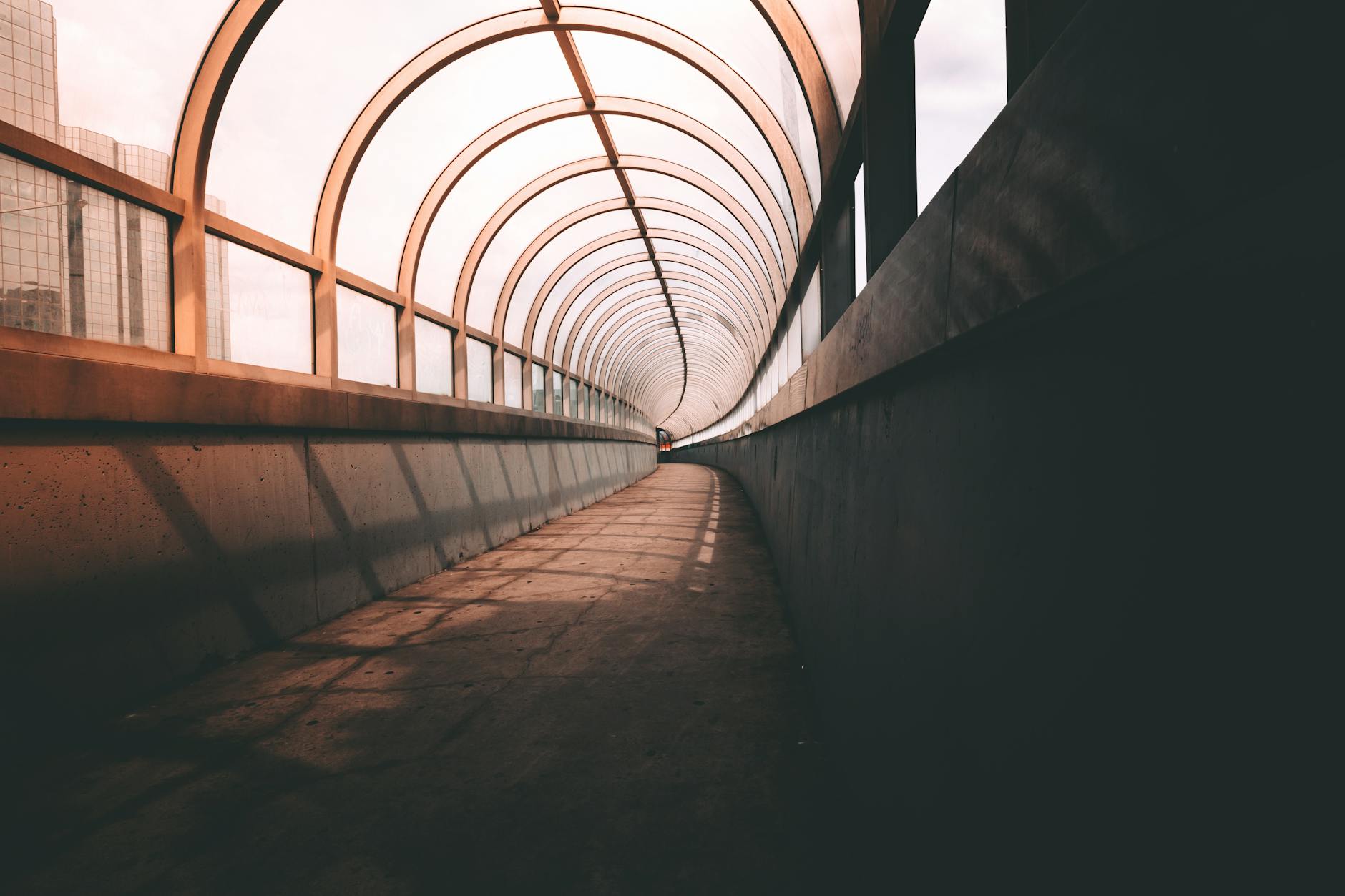
Entry point: frame edge or corner. Lines that enter the frame from the edge — particularly the lower-left or lower-right corner — create maximum compositional pull. The viewer’s eye enters the image at the edge with the line, follows it inward, and arrives at the focal point. This journey through the frame is more engaging than a line that starts in the middle with no visual entry point. When scouting a scene, walk around until the leading element enters the frame at its strongest entry position.
Combine with the rule of thirds. A line’s destination needs to be compositionally strong. If a road leads the eye toward a barn and the barn sits in the exact center of the frame, the composition is technically sound but visually static. Position the frame so the road enters from a lower corner and the barn sits at an upper-third intersection. Both compositional tools work simultaneously. The rule of thirds guide covers the intersection points and how to use them; lines and thirds are most powerful when the line terminates at one of those points.
The line needs a destination. A leading line with nothing at its end builds visual expectation and doesn’t deliver. The road that leads into fog, the path that ends at a blank wall, the converging tracks with nothing at the vanishing point — these are compositions that start but don’t finish. The line brings the eye to the emphasis point of the image — and if there’s no emphasis point, the line has nowhere to deliver the attention it gathered. The line is the journey; the subject is the destination.
Focal length and perspective. Wide-angle lenses (16–24mm) exaggerate perspective — parallel lines converge faster, the foreground looms large, and the sense of depth is pronounced. Telephoto lenses (85–200mm) compress perspective — parallel lines barely converge, everything in the frame appears at similar scale, and the sense of depth is flattened. For dramatic leading-line compositions, wide is almost always the better choice. Get physically close to the beginning of the line, shoot wide, and let the perspective do the work.
Shooting height. This changes everything. Converging tracks shot from 3 feet off the ground are a different image than converging tracks shot from standing height. Get low — sometimes significantly low — and see what the perspective does to the line geometry. Elevated perspectives (from a bridge, a hill, a drone) turn street-level lines into pattern-based top-down compositions. Default to eye level only when eye level is the most interesting position, not because it’s the easiest.
Combine line with foreground depth. A strong leading line that also incorporates a foreground element creates layering: near, middle, far. The viewer’s eye begins with the foreground anchor, follows the line into the middle distance, arrives at the subject in the background. Three spatial planes in one image is more dimensional than two. This is why wide-angle landscape compositions with strong foreground rocks, flowers, or grass leading to a distant mountain consistently produce depth that telephoto compressed images can’t match.
Landscape. The genre most associated with leading lines because the physical scale of the elements — rivers, mountain ridgelines, forest paths — makes the lines inherently prominent. The S-curve river is landscape photography’s default leading-line composition for good reason: it works across almost any lighting condition, any season, and any skill level. The deeper principles of how compositional elements work together in wide-scene landscape images — foreground, midground, horizon, sky — are covered in the landscape photography guide.
Street and urban. The city is a grid of converging lines at every scale: streets converging at intersections, tram lines running to a vanishing point, escalators rising diagonally through transit stations, pedestrian crossings creating horizontal bands across the frame. Street photography relies on line more than most genres acknowledge — not as deliberate composition but as the readymade structure of urban environments. The photographer’s job is to align to it.
Architecture. Buildings designed with classical or modernist principles are full of intentional line work: columns that recede, arched tunnels that converge, staircase spirals that function as pure leading-line compositions. Interior architecture is particularly rewarding — a long library corridor, a vaulted church nave, a glass-and-steel office lobby with repeating structural elements. The key constraint: you need to be at one end of the line, not beside it. Standing at the entrance of a corridor looking down it is the shot; standing beside the corridor looking across it gives you the same architecture and none of the line.
Portrait. Less discussed but genuinely applicable. A subject standing against a wall of brick, with the horizontal mortar lines receding behind them, is using architecture as a leading element that frames the person. A subject at the end of a corridor, a person on a bridge with the railings converging toward them, a figure at the end of a path — environmental lines used to draw attention toward a person rather than a landscape or building. The line serves the emphasis function: it communicates “this is where to look.”
Lines that exit the frame without a destination. A diagonal line that runs from the lower-left corner to the upper-right and exits through the edge of the frame takes the viewer’s attention and removes it from the image. The eye follows the line and leaves. Reframe so the line terminates at something — or bends back before it reaches the edge.
Multiple competing lines with no hierarchy. A busy urban intersection might have converging roads, shadow lines, pedestrian crossing stripes, and architectural edges all going in different directions. This can be chaotic or it can be interesting depending on whether one line is clearly dominant. If the lines compete with equal weight, the image is visually noisy. Compose so one line is stronger — through its contrast, length, or placement in the frame.
Vanishing point in the center. A road aimed directly at the center of the frame is technically a leading line but compositionally weak — it aims at the most static point in the image. Shift the camera until the vanishing point falls at a third-line or intersection. The same convergence produces a more dynamic result.
Forgetting that lines require a destination. Covered above, worth repeating: a line that leads nowhere doesn’t serve a compositional function. Before committing to a leading-line composition, confirm what the line leads to and whether that destination justifies the journey.
Shooting only from standing eye level. Eye level is the least interesting position for most leading-line compositions. Get lower. Architectural lines shot from below have vertical power that eye-level misses. Street lines shot from 2 feet off the ground exaggerate perspective in ways that transform ordinary compositions into visually dramatic ones.
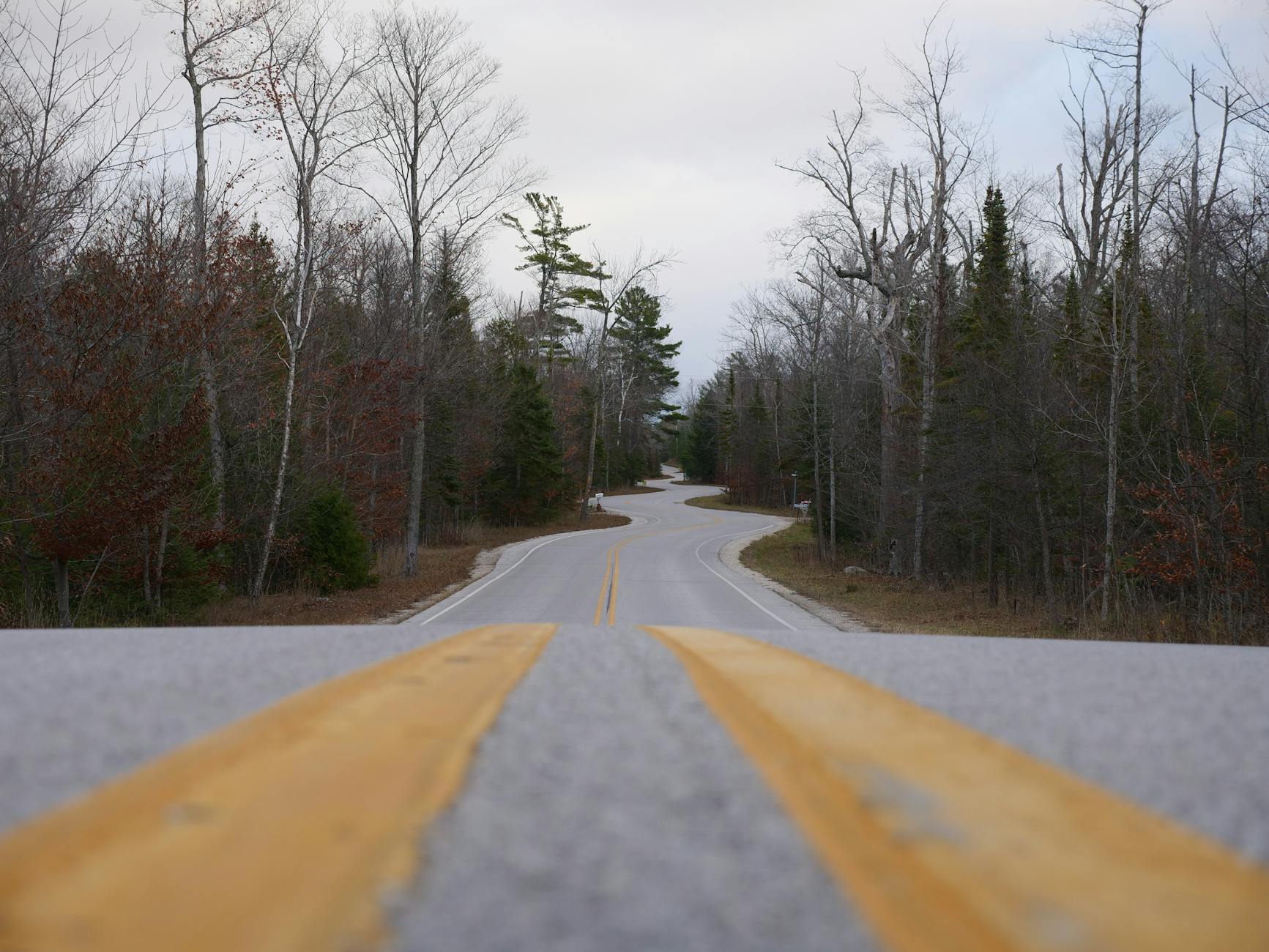
Go somewhere with a clear physical line — a road, a path, a hallway, a fence, any edge that extends for some distance. Photograph it from five different positions:
Compare the five images. The subject is identical in all five. What changes is how the line behaves — its angle, its rate of convergence, the proportion of frame it occupies, and how strongly it pulls the eye. The exercise takes 15 minutes with any camera and permanently changes how you read scenes in terms of line and angle rather than subject.
What are leading lines in photography?
Any element that guides the viewer’s eye through the frame in a specific direction. They can be physical lines (roads, rivers, fences), architectural structures (corridors, staircases), shadow patterns, or implied directions (a gaze, a row of objects). Their function is to create visual movement through the frame and to direct attention toward a focal point.
What are the different types of leading lines?
Straight (horizontal, vertical, diagonal), converging (two or more lines meeting at a vanishing point), curved, S-curve, and implied. Diagonal lines create energy; horizontals create calm; converging lines create depth; S-curves create flow; implied lines work through the suggestion of direction without a physical continuous element.
What’s the difference between a leading line and just a line in a photo?
Intent and function. A line in a photograph that doesn’t guide the eye toward anything is just a structural element. A leading line is specifically positioned to draw attention from where it begins to where it ends — and what it ends at should be the image’s focal point. The leading function is in the composition, not the line itself.
Do leading lines have to be straight?
No. Curved lines, S-curves, and implied directional lines all function as leading lines. The type of line affects the emotional quality of the movement — straight and diagonal for energy, curved for flow, S-curve for rhythm — but the guiding function is the same.
